
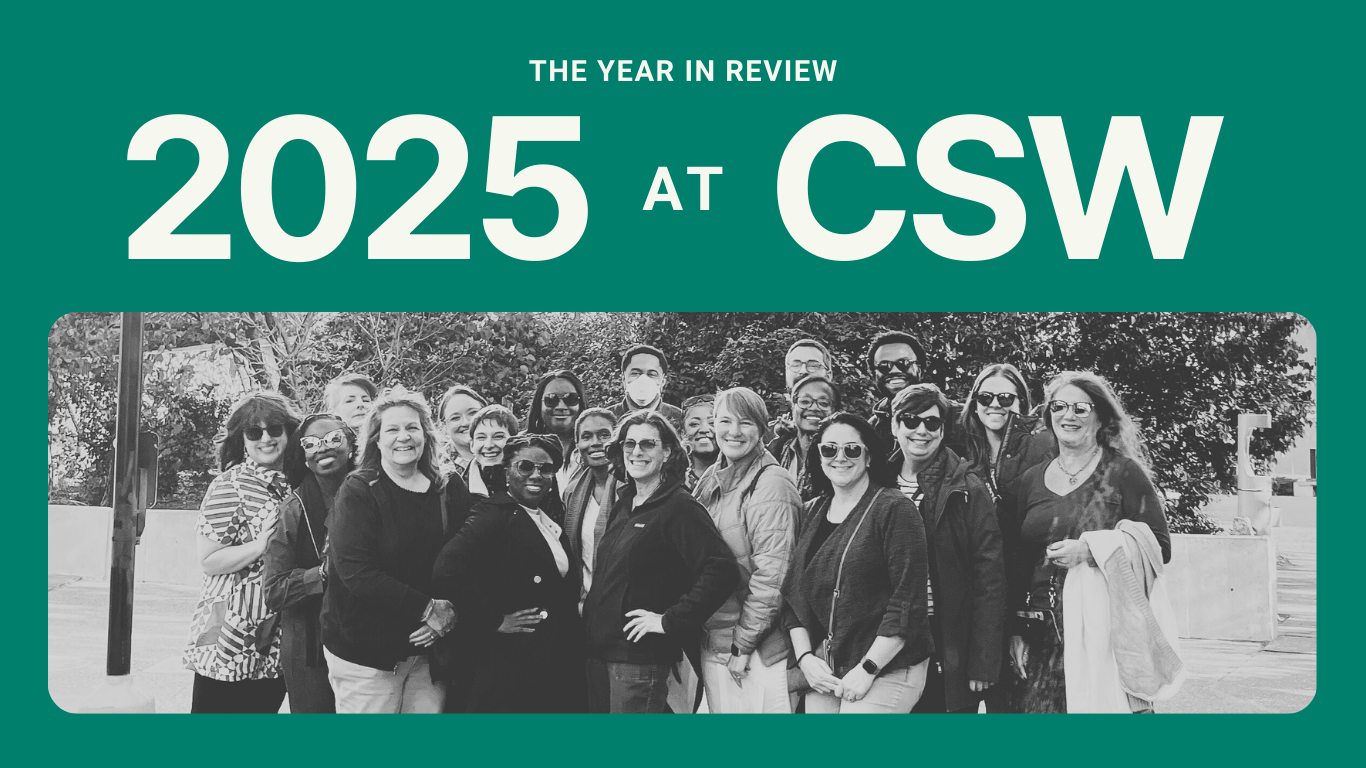
As the new year begins, we want to pause to celebrate CSW’s many accomplishments over the past twelve months. 2025 was fraught with political and funding uncertainty, creating a challenging landscape in workforce development. Yet, CSW continued to grow our staff and managed over 50 unique projects.
Over the course of the year, we added four new staff to the CSW team: Denean Pillar-Jackson was hired as a Senior Policy Associate for our Trauma & Resilience at work team; Danielle Waddell and Dana Westgren were both brought on as Senior Policy Associates for our Federal, State, & Local Systems Change team; and Joy Briscoe was hired as the Director of our Improving Practices & Outcomes team. Additionally, CSW’s Board of Directors grew with the addition of Ashley McIver, the Community Investments Director for Communities Foundation of Texas.
In 2025, we maintained high Gallup Poll results, with 95% of staff rating CSW as a desirable place to work. Our Gallup Poll responses saw increases in 11 of the 12 survey questions over previous years, showcasing particularly high marks among the following prompts:
- The mission or purpose of my company makes me feel my job is important
- My coworkers are committed to doing quality work
- My manager, or someone at work, seems to care about me as a person
CSW remains committed to supporting racial equity and inclusion, despite ongoing anti-DEI efforts. In 2025, we reaffirmed these beliefs and provided what support we could to our peers and partners:
- Helpful Resources for Promoting Access in Anti-DEI Times
- Self-Care and Building Resilience in Challenging Times
- Lessons from the Poor Peoples Campaign: Considerations for Economic Mobility in 2025
- How to Improve Workplace Culture and Increase Psychological Safety at Work
Throughout all the changes that 2025 brought, both promising and challenging, we have remained committed to providing quality jobs to not only our staff, but to those in communities across the country. We spent the year collaborating on many different pieces of work, all aimed at improving economic outcomes for learners and workers. These are a few of the most notable projects:
Work Supporting Youth & Young Adults
Designing Workforce Systems Change for Youth, with Youth
Funding provided by the Conrad N. Hilton Foundation
California’s workforce system serves nearly 500,000 Opportunity Youth ages 16–30 who are disconnected from school and work and who are navigating overlapping barriers such as poverty, homelessness, justice involvement, disability, and trauma. While the state has elevated Opportunity Youth as a priority through the Master Plan for Career Education, Jobs First, and legislative action, existing systems are siloed, challenging the work of preparing Opportunity Youth for stable, future-facing careers.
Through a Hilton-funded partnership with the Labor & Workforce Development Agency, CSW developed a statewide strategy to operationalize California’s Opportunity Youth policy commitments into practical, youth-centered systems changes that improve outcomes today while remaining adaptable to labor market disruption. Building on this foundation, CSW and partners, including WestEd’s Center for Economic Mobility and UniteLA, launched the Opportunity Youth Systems Change Demonstration Project in Los Angeles County as the next phase of this work, applying a design-thinking, youth-led approach to test and refine system-level solutions in healthcare career pathways. By embedding youth leaders in cross-sector teams, prototyping solutions, and generating actionable lessons for scale, the LA project translates statewide vision into on-the-ground systems change that can be replicated across California.
Related Publications:
The Learner-Centered Benchmarking Project (LCBP)
Funding provided by the Annie E. Casey Foundation
Across workforce, human services, and postsecondary systems, there is growing recognition that centering learner voice leads to stronger, more equitable outcomes. Despite good intentions, traditional student engagement approaches in community colleges such as surveys, focus groups, or advisory roles, are often episodic, reactive, and limited in their ability to shift power or drive lasting change. These methods rarely account for the different realities facing young people depending on whether they are connected to school, work, both, or neither. As a result, institutional decisions frequently fail to reflect the needs, priorities, and insights of students with the highest levels of unmet need.
To address this challenge, CSW developed the Learner-Centered Benchmarking Project (LCBP), a participatory action research-inspired approach that treats students as experts in their own lived experiences and as partners in systems improvement. Working with Kennedy-King College, the LCBP implements a train-the-trainer model, equipping institutional leaders, faculty, and staff with tools and processes to embed participatory action research-informed practices beyond a single project or grant cycle. The LCBP elevates worker and learner perspectives in program design and evaluation, providing a human-centered framework that helps practitioners, funders, and policymakers measure impact and align services with what people value and need.
State Strategies
Certified Direct-Care Worker (CDCW) Credential
Funding provided by Michigan State University
An aging population is driving soaring demand for direct care workers, the most in-demand job in many states. Yet the number of direct care workers remains too small to meet current and future needs, compounded by historically low job quality and high turnover. Despite their essential, highly skilled work, direct care workers are not fully recognized as professionals. Their expertise is undervalued, and career pathways are unclear, limiting their advancement and visibility.
CSW is supporting its partner IMPART Alliance at Michigan State University, with funding from the Michigan Department of Health & Human Services, to develop an industry-recognized, competency-based “Certified Direct Care Worker” (CDCW) credential to elevate the profession and strengthen pathways into direct care and broader healthcare careers. Our support includes co-developing the four stackable CDCW credentials, facilitating a participatory competency-design process with workers and employers, helping draft and pilot assessment items, conducting psychometric review, and engaging state and industry champions to support adoption. Together, these efforts ensure the CDCW is rigorous, equitable, and positioned to be embedded in hiring, training, and advancement systems statewide.
Related Publications:
- CSW Supporting IMPART Alliance in Creating a Direct Care Worker Infrastructure in Michigan
- Professionalizing the Direct Care Workforce: Developing Competency-Based Credentials
Workforce Systems Through the AI Transition
Funding provided by the Michigan Office of Labor and Economic Opportunity
As artificial intelligence reshapes labor markets, states are increasingly focused on how to position their workforce systems to respond to rapid technological change. With more than half of workers reporting they feel unprepared to use AI tools, policymakers and administrators face growing pressure to ensure that AI adoption supports job quality, skills advancement, and equitable access to opportunity.
In Michigan, the Department of Labor and Economic Opportunity partnered with CSW to develop the state’s AI and the Workforce Plan, a strategic framework designed to integrate AI skills across education and training systems, expand digital inclusion, support worker transitions, and guide responsible AI adoption among small and mid-sized businesses. This work builds on Michigan’s Statewide Workforce Plan, which CSW also supported and which establishes an equity-centered approach to addressing skills gaps, labor force participation, and access to quality jobs by strengthening alignment across workforce, education, and economic development systems. Together, these plans provide a coordinated foundation that enhances Michigan’s capacity to anticipate labor market change, align cross-agency action, and manage technological disruption in a systematic and inclusive manner.
Related Publications:
- Michigan’s AI & The Workforce Plan
- The Michigan Statewide Workforce Plan
- Future-Ready States: Building a Workforce that’s Ready for AI
Communities of Practice & Learning Cohorts
Partnering Economic & Employment Research (PEER) Academy
Funding provided by Ralph C. Wilson, Jr. Foundation and Ballmer Group; Partnering with the New York Association of Training and Employment Professionals (NYATEP)
Access to accurate, easily shared labor market information (LMI) data is an essential resource to help workforce and economic development practitioners better understand local demographic trends, business and talent development needs, and their choices for investing public and private resources. Yet, labor market information data sources can be fragmented, hard to interpret, or not tailored to the unique needs of smaller regions and specific programs.
To combat this issue, CSW and NYATEP developed the Partnering Economic & Employment Research (PEER) Academy for 16 workforce and economic development professionals from Southeast Michigan and Western New York. During the 9-month series of retreats and workshops, fellows received lessons on how to independently collect and use LMI data to better guide program development, industry recruitment and engagement, and to help residents make better choices about available jobs, workforce education and training programs, and career pathways.
Related Publications:
- PEER Academy, a Labor Market Information (LMI) Training Cohort, Announced
- PEER Academy Cohort Participants Announced
- CSW Releases Workforce Development Data Toolkit
Quality Data
Evaluation of the Build Better Careers Initiative Sites 1 and 2 (Charlotte, NC and Memphis, TN)
Funding provided by Truist Foundation and Strada Education Foundation; Partnering with CAEL (Council for Adult and Experiential Learning)
The workforce development ecosystem invests significant resources in programs and strategies to improve outcomes for learners and jobseekers. Understanding what is effective, why, and for whom is essential for continuous improvement, maximizing impact, and knowing which strategies to scale, adjust, or discontinue.
This year, CSW completed its evaluation of two Build Better Careers sites, an initiative focused on creating education-to-career pathways in the financial services industry for women and BIPOC residents. CSW leveraged its evaluation capacity as well as long-standing industry sector partnerships experience to conduct the evaluation. Throughout the project, CSW translated findings into actionable insights for future sites, and the field, on how to best advance economic mobility for women and BIPOC residents in financial services.
2025 Workforce Benchmarking Network New York City Cohort
Funding provided by The Harry and Jeannette Weinberg Foundation, The Pinkerton Foundation, The Ira W. DeCamp Foundation, and Deutsche Bank.
To build the data capacity of New York City workforce development organizations, CSW partnered with New York City Employment and Training Coalition (NYCETC) to lead an equity-focused Workforce Benchmarking Network (WBN) cohort. The 2025 WBN NYC cohort convened more than 70 practitioners representing 16 direct service workforce organizations. While participating organizations offered robust services, 2025 WBN NYC data revealed persistent performance and equity challenges, including lower program completion and job placement rates compared to national benchmarks, widening gaps by gender, and a sharp decline in employer engagement, particularly around job quality, advancement, and worker engagement practices.
In response, CSW and NYCETC delivered a cohort model that combined peer learning, individualized technical assistance, and benchmarking tools to strengthen data culture and practitioner data acumen. Through the WBN National Survey and accompanying coaching, organizations learned to use disaggregated data to identify service and outcomes gaps, assess impact beyond required program measures, and translate insights into program and policy changes. As a result, cohort members were better equipped to leverage data for continuous improvement, articulate impact to funders, elevate participant voice, and advance more equitable workforce outcomes across New York City.
Related publications:
- 2025 WBN NYC Cohort Announced
- WBN NYC Spotlight: How Reel Works Transformed Their Alumni Engagement Using Data
- WBN NYC Spotlight: How Sakhi is Using Data to Empower Participants and Improve Outcomes
- About the Workforce Benchmarking Network (WBN) Cohorts
Sector Strategy Support
Good Jobs Challenge: Richmond-Petersburg Advanced Pharmaceutical Manufacturing (APM) Workforce Initiative
Funding provided by Reynolds Community College, with a grant from the U.S. Department of Commerce
Despite ongoing efforts, a disconnect persists between the skills employers need and those workers gain through credentialing. This gap grows even wider when new industry sectors emerge with rapidly evolving roles, outpacing the ability of credential providers to prepare workers for newly created jobs. To meet current hiring needs and prepare for the rapidly evolving skills required in the future workforce, stronger, more coordinated partnerships among higher education, community-based training programs, and industry are essential.
CSW is supporting the Richmond-Petersburg Advanced Pharmaceutical Manufacturing Workforce Initiative, led by the Community College Workforce Alliance, to build a scalable workforce system for Virginia’s growing APM and biotechnology sectors. CSW’s work includes developing competency-based occupational profiles, mapping career and education pathways, analyzing gaps, and aligning occupational competencies with training and program outcomes.
Related Publications:
Everett Community College Information Technology Career Pathways Map
Funding provided by Everett Community College
Access to accurate and accessible career information is essential to advancing economic mobility and job quality. Yet, today’s jobseekers, workforce professionals, and educators often lack timely insights into emerging, high-quality career opportunities and their pathways for advancement.
To support learners with access to this information in the Everett Community College Information Technology Program, CSW developed a career pathways map to help their prospective students, current students, and counselors understand regional in-demand occupations in the field. The map included data on typical wage ranges, common job titles in job postings, top credentials/certifications requested, as well as the typical time needed to advance, and was validated by regional employers and students.
Scaling Manufacturing and Renewables Training (SMART) Iowa
Funding provided by Hawkeye Community College
As states accelerate the transition to clean energy, advanced manufacturing, and new technologies, workforce systems are being tested by the scale and speed of industry change. In Northeast Iowa, manufacturers must upskill workers for automation and electrification. Through SMART Iowa, CSW is helping the region respond by aligning industry demand, workforce systems, and equitable career pathways. CSW is developing labor market intelligence, occupational profiles, and career pathway maps which are learner- and employer-validated. These efforts move beyond short-term interventions to strengthen the systems that support workers through industry transitions, creating scalable models for more resilient, inclusive workforce development in the face of ongoing economic change.
Related Publications:
Displaced Oil & Gas Workers Fund (DOGWF)
Funding provided by the CA Employment Development Department
As California transitions to green energy, thousands of workers in the oil and gas industry will need to transition to new jobs and industries; careers that pay well and provide growth opportunities. CSW is helping the state minimize barriers for those oil and gas workers and ensure communities are not left behind, providing support as oil and gas workers are navigating transitions into new, family-sustaining careers. CSW is providing technical assistance, evaluation, and peer learning to workforce boards, colleges, unions, and community partners. Additionally, we are working to create an industry transition blueprint that can be replicated for future labor market disruptions caused by climate policy changes, technological innovations, or other economic shifts, making this both a workforce development initiative and a model for how states can more effectively respond to planned economic transitions.
Related Publications:
Detroit Area Workforce Funders Collaborative & Trinity Health (HQ MI)
Funding provided by National Fund for Workforce Solutions
Trinity Health is facing persistent challenges retaining frontline medical and service workers as low wages, burnout, and limited advancement opportunities drive turnover across roles that are essential to patient care and daily operations. While efforts are underway to strengthen career ladders across six frontline employee clusters, these initiatives are often disconnected from retention strategies, leaving workers with few visible pathways for growth and reinforcing a cycle of exit rather than advancement. This dynamic focuses on Trinity’s ability to maintain a stable workforce and meet operational demands, raising an urgent need to better align job quality, mobility, and equity goals.
In response, CSW and the Detroit Area Workforce Funders Collaborative partnered with Trinity Health on a four-phase, four-month pilot that analyzed workforce data, elevated frontline voice, explored cross-sector partnerships, and surfaced practical solutions, resulting in actionable recommendations that link retention with advancement and lay the groundwork for more equitable, sustainable career pathways.
Capacity Building in Workforce Development and Human Services Systems
Michigan NEAR Ambassador Collaborative
Funding provided by Michigan Department of Health and Human Services
Ninety percent of adults have experienced at least one traumatic experience in their lives, and 60 to 70 percent have experienced Adverse Childhood Experiences (abuse or neglect before the age of 18). These experiences can undermine their success in life and work. The Michigan Department of Health and Human Services (MDHHS) has committed to ensuring that their programs and services are trauma-informed to better serve these participants.
MDHHS hired CSW to train a cohort of staff across state agencies including MDHHS, Education, and Labor and Economic Opportunity, on trauma-informed practices, policies, and leadership. CSW coached staff on creating and implementing action plans to embed trauma-informed principles into their agency systems and materials. Post-project evaluation results showed strong learning outcomes and meaningful skill development.
Related Publications:
Trauma-Informed and Resilient (T&R) Somerville
Funding provided by Jobs Creation and Retention Trust in Somerville, MA
In early 2024, the Somerville Jobs Creation and Retention Trust Board (JCRT) identified trauma and mental health stress as a challenge for local workforce development and adult education staff. They were struggling with the traumatic experiences their low-income and immigrant participants were experiencing, secondary trauma, and the stress of working with participants with limited means in a funding and resource constrained environment.
Funded by the JCRT, CSW implemented Trauma-Informed and Resilient (T&R) Somerville to support workforce development, adult education, and social service staff in building a trauma-informed, healing-centered, and resilience-building system. A cohort of 18 staff took part in a year-long series of trainings and action labs that explored how trauma shows up in the workplace, strategies to build resilience, approaches to trauma-informed leadership, and ways to strengthen organizational culture.
Related Publications:
Support Our Work in 2026
Thank you for believing in CSW’s work. As we enter 2026, we’re preparing for a new year full of bigger and bolder projects than ever. You can play a part in this change too.
Comments are closed.