


When I began my career as a social worker, discussions about any type of trauma were rare. At that time, my work was in the Temporary Assistance to Needy Families (TANF) program, which was going through a significant shift in how they provided services. TANF social workers were beginning to work closely with recipients, inviting them to share their career goals and supporting them collaboratively through job placement and training services. Every day, I met remarkable women, mostly single mothers, who demonstrated great resilience despite systemic and personal challenges.
While I had been trained to develop employment plans and make referrals, I was not prepared to recognize or manage the emotional toll of hearing clients’ experiences of violence and trauma. Over time, my empathy became strained, and it was difficult to stay hopeful rather than become overwhelmed. I didn’t have the words for it then, but what I was experiencing was vicarious trauma. Like so many of us who support people going through difficult experiences, I was carrying the weight of their stories with me. This quiet heaviness often goes unseen and unsupported. Understanding and addressing vicarious trauma is vital for workplace mental health and keeping our work sustainable.
Secondary Trauma vs. Vicarious Trauma vs. Indirect Trauma – What’s the Difference?
Vicarious trauma, also called secondary trauma, indirect trauma, or compassion fatigue, happens when we are deeply affected by others’ trauma, pain, anxiety, and other strong feelings without directly living them ourselves. Even without a personal trauma history, exposure to clients’ pain can deeply impact our emotional, physical, and mental health. This is a natural response to witnessing the helplessness, fear, and hopelessness that others who have experienced trauma often feel.
The following terms are often used as synonyms for “vicarious trauma,” and while they do overlap, there are some subtle differences:
Trauma is an event, series of events, or set of circumstances that is experienced by an individual as physically or emotionally harmful or life-threatening and that has lasting effects on an individual’s functioning and mental, physical, social, emotional, or spiritual well-being. Traumatic events may be experienced by an individual, a generation, or an entire community or culture. This includes the historical and ongoing racial trauma experienced by many communities.
Indirect, secondary, or vicarious trauma are a subtype of trauma where the trauma is not experienced directly, but where service providers are left with a lasting impact caused by exposure to clients’ trauma. Compassion Fatigue is like vicarious trauma but is a one-time event and may occur suddenly as opposed to vicarious trauma or burnout, which are from buildup over time.
Burnout goes beyond compassion fatigue and involves a cumulative state of emotional exhaustion and dissatisfaction resulting from chronic workplace stress, which is often compounded by institutional and racialized stressors on professional staff. Vicarious trauma is one potential cause of job burnout which can include other stressors, such as unclear job expectations, high workloads, and/or a constantly chaotic workplace.
What are common signs of vicarious trauma?
Potential signs and symptoms of vicarious trauma in the workplace are the same as with all types of trauma (acute, chronic, complex/developmental, organizational, and collective) and could include:
- Physical: headaches, fatigue, stomach or joint pain, impaired immune system
- Emotional/psychological: difficulty falling/staying asleep, feeling trapped by one’s work, increased frustration, hopelessness, disengagement, mood swings
- Cognitive: cynicism, pessimism, feeling like a failure, preoccupation with thoughts about clients or their families
- Interpersonal: tensions or conflicts in relationships, changing the way one communicates, becoming withdrawn from other staff
- Behavioral: difficulty leaving work at work, irritability and outbursts at work, being consistently absent from work, working too hard with little or no breaks
- Spiritual: questioning one’s faith and/or values, wondering why they even bother to try
Who might experience vicarious trauma?
Vicarious trauma can affect all helping professionals—not only clinicians, but also workforce development practitioners, managers, and leaders who maintain trusted relationships with clients. Workforce clients and participants seek support because they have barriers to employment which often can be traced back to trauma. As part of the working relationships, participants often share these barriers or trauma with practitioners.
Vicarious trauma can lead to symptoms that disrupt our well-being and effectiveness. The signs can be subtle, as seen in the list above. If left unaddressed, they can lead to reduced empathy, diminished effectiveness in roles, significant personal distress, and ultimately, job burnout. As managers, it is crucial to recognize these symptoms early and foster ongoing, honest dialogue rooted in cultural humility and racial equity about emotional wellness. Addressing vicarious trauma early and engaging in collective care at work can help individuals and teams be productive and healthy and hopefully increase job quality rather than result in staff burnout.
How the COVID pandemic amplified trauma and vicarious trauma
Before the pandemic, workforce professionals primarily focused on “job-ready” job seekers— individuals who were prepared to work and had manageable barriers to employment. The pandemic, however, reshaped the role of workforce professionals entirely. Suddenly, staff were not just helping people find jobs but became critical lifelines in moments of crisis. They distributed school supplies, coordinated COVID-19 testing and met clients in nontraditional settings like parking lots.
This shift meant listening to stories of illness, job loss, and family instability on a constant basis. For many workers, especially those hired for their lived experience, the line between professional and personal became blurred. The overwhelming demands—and the constant exposure to client trauma—left workforce professionals carrying an emotional weight beyond their usual scope of work.
This shift led to widespread exhaustion and burnout, compounded by personal losses and stress at home. Recognizing these pressures is crucial as we navigate a post-pandemic landscape characterized by budget constraints and heightened service demands. Promoting healing requires collective solutions grounded in shared accountability, racial justice, and systemic change, rather than isolated individual self-care.
Using Collective Care to Support Staff Experiencing Vicarious Trauma
For many, “self-care” is often seen as hikes in nature or rest and relaxation outside of the workplace—well-intentioned but not enough to counter the weight of trauma exposure. What truly supports healing is collective care rooted in antiracist and trauma-informed practices, where organizations incorporate structural awareness and cultural humility to provide safe, ongoing spaces for employees to share and process their experiences.
Collective care encompasses self-care and goes further:
- Encourages us to see well-being as a shared responsibility of the wider group;
- Fosters an environment where staff can openly share feelings of being overwhelmed by work and client stories without fear of shame; and
- Requires effort at every level of an organization.
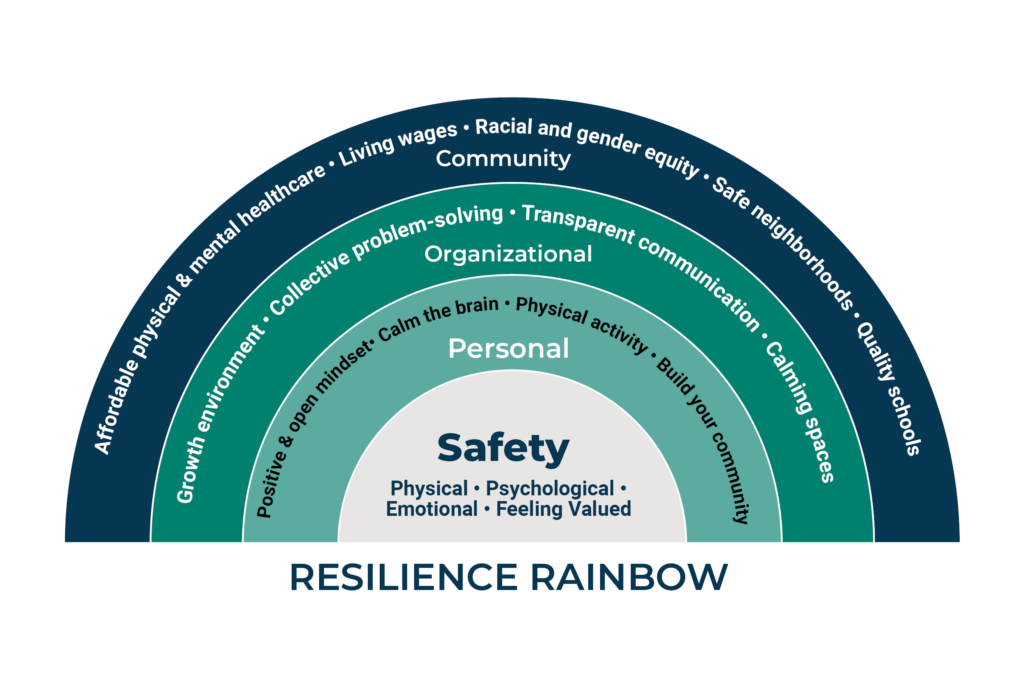
CSW developed the resilience rainbow to illustrate that resilience and collective care needs to be addressed on multiple levels.
What Organizations, Managers, and Leaders Can Do
- Integrate trauma-informed and antiracist language and practices into job roles and organizational policies.
- Provide structured opportunities for debriefing via one-on-ones, small groups, or employee assistance programs.
- Support staff who need time off, without stigma or fear of judgment.
- Model empathy, forgiveness, vulnerability, and genuine care across teams in ways that honor diverse cultural experiences.
- Create safe spaces for regular check-ins, peer support groups, and co-care practices that explicitly address racial and cultural factors in workplace wellness.
- Enforce policies that respect boundaries, such as no emails on weekends.
- Promote consistent conversations about wellness, not just crisis response, grounded in cultural humility.
- Offer relevant training and practical resources that connect to frontline realities and include racial equity education.
- Develop peer-to-peer mentorship or buddy systems to build multiple support channels.
What You Can Do as an Individual
- Learn to recognize signs of vicarious trauma and compassion fatigue in yourself and colleagues, including how racial and systemic stressors may influence your experience.
- Prioritize moments of pause to process emotional responses and ask for help.
- Initiate honest discussions about challenges with trusted teammates or supervisors, approaching these with cultural sensitivity and openness to growth.
Resources to Get Started
- Olga Phoenix Self-Care Wheel: Helps you assess yourself across six areas of your life (psychological, emotional, spiritual, personal, professional, and physical) and develop a holistic plan to nourish areas and build your own resilience and well-being.
- Brief on Caring for Ourselves as We Care for Others: A six-page brief that defines vicarious trauma, provides steps to prepare for our natural reactions of vicarious trauma, helps us understand our own triggers, and how to cope with our triggers.
- Facilitating Conversations for an Anti-Racist Workplace Guide: a guide by the Michigan Medicine University of MI that provides facilitator tips, guidelines for engagement, and meeting templates.
- Practices to exercise your brain’s resilience and flexibility:
- Practice rewiring: challenge your brain
- Practice reframing as opportunities
- Practice having a growth mindset (flexibility)
- Practice simplicity, pushing pause
- Meditation Apps: Insight Timer, Calm, Headspace, Mindful.org
- NYT 10 Ways to Keep Your Mind Healthy in 2025
- Rain of Self-Compassion
- The 5 Directions – Trauma Stewardship
- The Miracle of Mindfulness: An Introduction to the Practice of Meditation
- Becoming a Trauma-Informed Organization – Behavioral Health Workforce Center
- Workforce Resilience Enhancement Project
Building a culture of collective care requires courageous leadership and real change in the systems we work within, especially those that center on racial justice and cultural humility. It can be uncomfortable to question existing systems or call out where support falls short. Sometimes, the bravest act is demanding change—or choosing to leave environments that don’t prioritize well-being and equity.
Despite these challenges, this work is deeply rewarding. Today, choose one simple action: check in with a colleague, share a moment of kindness, or create space for a difficult conversation. Together, these small steps build healthier, more equitable workplaces where both clients and providers can thrive.

Meet the Author
Amanda Gerrie
Amanda Gerrie is a Senior Policy Associate on the Federal, State, & Local Systems Change team. In this role, she supports CSW in developing high-impact initiatives focused on producing more just and equitable federal, state and local systems.

Meet the Author
Patricia Maguire
Patricia is a Senior Policy Associate with CSW’s Trauma and Resilience at Work team, working to advance workplaces and workforces that are culturally responsive, trauma-informed, resilience-building, and supportive of mental well-being.
Comments are closed.