

For years, Michigan’s agriculture and food system has depended on workers, including migrant and seasonal farmworkers, to keep fields productive and supply chains moving. Yet, many food system jobs, including those in production and retail, fall short of what defines a quality job: one that provides family-sustaining wages, access to benefits, opportunities for advancement, and consistent, predictable schedules. The path to transitioning into higher-quality work from these positions is often unclear or inaccessible; the same is true across industries more broadly. Quality jobs exist, but quality career pathways—the clear, structured routes that help individuals move from entry-level roles into higher-wage, higher-quality work—are often invisible, fragmented, or misunderstood.
So, what is a career pathway? At its core, a career pathway is a structured sequence of education, training, and work experiences that enables individuals to progress over time within a specific industry or occupation. Effective pathways include multiple entry and exit points, offer stackable credentials, and are aligned with real labor market demand. When designed well, they make advancement visible and achievable, especially for those starting with limited access to opportunity. Career pathways help jobseekers see themselves on a real path to economic mobility, not a dead end or a vague suggestion to “go get a bachelor’s degree.”
Career and Credential Pathway Maps and Occupational Profiles
It is critical that jobseekers know what their options are and what kind of life those options provide. Yet, today’s jobseekers, workforce professionals, and educators often lack timely insights into emerging, high-quality career opportunities and their pathways for advancement. This is especially true for jobseekers from low-income and underrepresented backgrounds who might lack personal connections or awareness of these roles without career navigation or counseling support.
Several powerful tools exist to help learners and workers navigate careers, and better understand potential career pathways in practice, including career pathway maps, credential pathway maps, and occupational profiles. These tools are most valuable when customized for a region or priority population to reflect local demand, hiring practices, and accessible entry points. For example, they can illustrate both starting roles and advancement opportunities that are realistic for individuals without a high school diploma or with limited prior experience.
To help address this gap for food system workers in Michigan, as part of the Michigan Agriculture and Food Systems Workforce Advancement Initiative (MAFSWAI) funded by the United States Department of Agriculture, CSW developed career pathway maps and occupational profiles in English and Spanish. These resources outline opportunities for food system workers to identify and apply their existing skills and knowledge toward higher-quality work with the right supports in place.
Career Pathway Maps
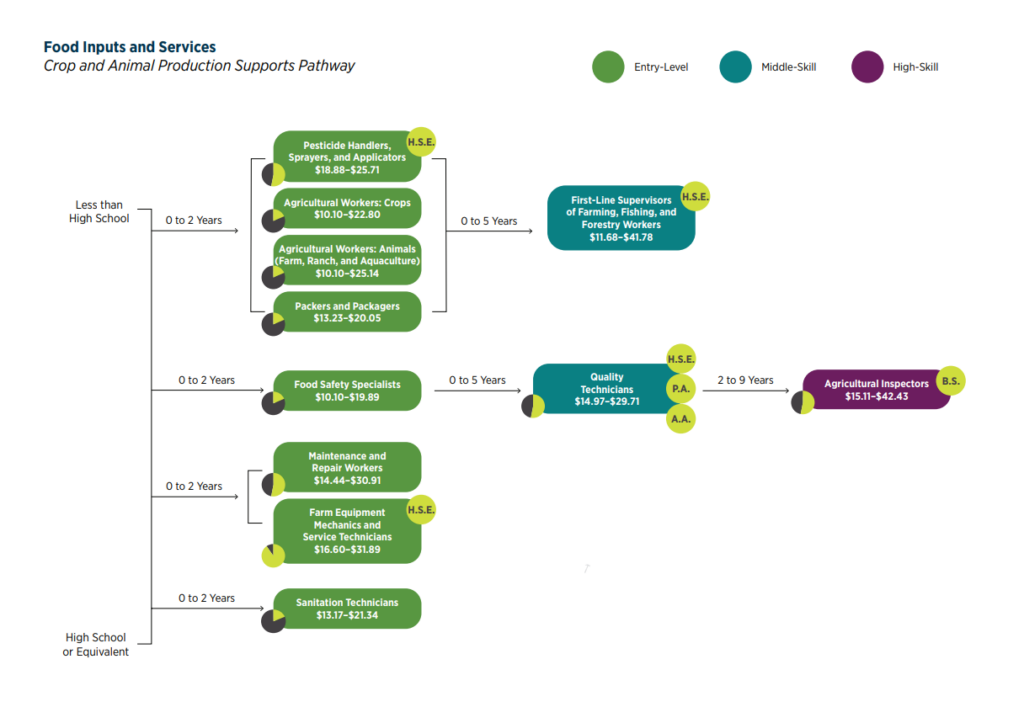
Career pathway maps show how someone can meaningfully enter an occupation from where they are today and move forward over time through a combination of work experience and training, including shorter-term, stackable credentials. These maps bring clarity to progression and make advancement tangible (see an example for Food Inputs and Services occupations below).
Career pathway maps can help many different users within a workforce system. They help jobseekers understand which jobs are in demand, what they pay, and which skills and competencies they need to demonstrate in order to access and advance in those jobs. They also support informed decision-making about which routes best help jobseekers meet their career and family goals. They also enable career navigators and career counselors to provide more tailored and detailed guidance, help business services professionals develop better quality jobs, and give employers and educators a shared framework for aligning talent needs with learning opportunities.
Occupational Profiles
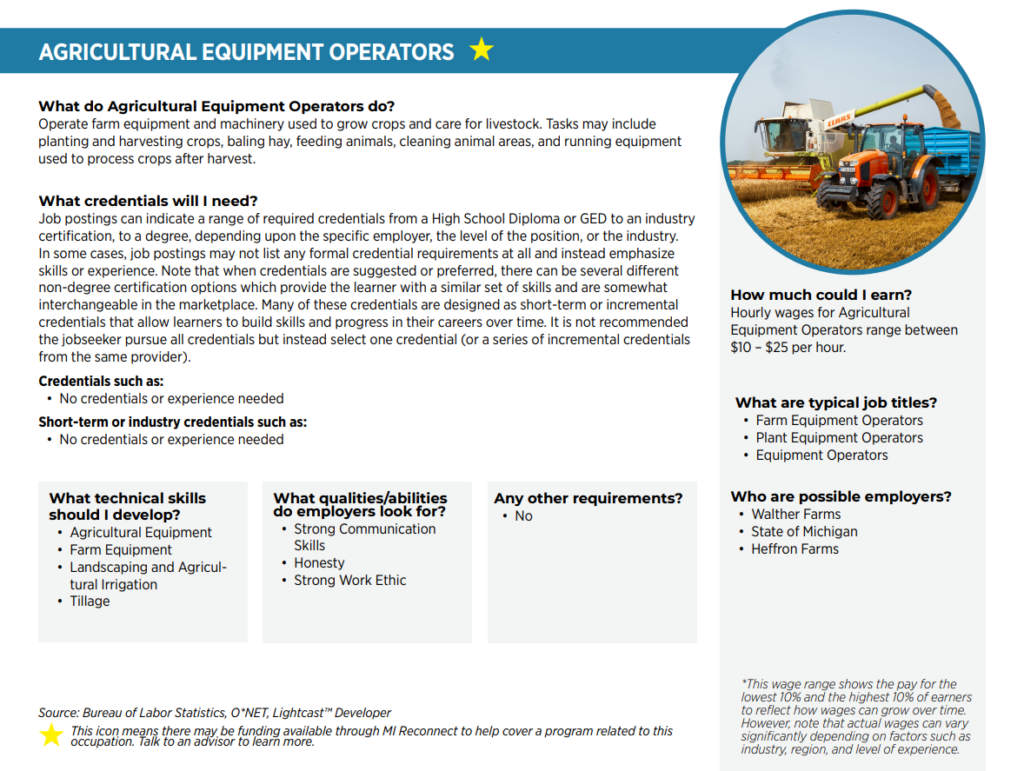
Occupational profiles complement career pathway maps by providing clear descriptions of what workers actually do on the job and the competencies required. Central to this is a clear definition of competencies: the measurable knowledge, skills, and abilities that individuals must demonstrate to perform effectively in a role. By making competencies explicit, profiles allow individuals to see what they already bring and what they need to build next. They outline the job functions, credentials, experience levels, and estimated regional wages associated with each role. Profiles can be created for both existing and emerging occupations, incorporating trends, employer insights, and competency-based analysis. They can also be designed for different audiences: learner or jobseeker-facing profiles help jobseekers in identifying future roles aligned to their current skills, provide a better picture of day-to-day work life in these roles, and can support incumbent workers with the language to articulate what they know and can do, for use in resumes and interviews (see an example for Agricultural Equipment Operators below).
Educational and Training Provider-Facing Occupational Profiles
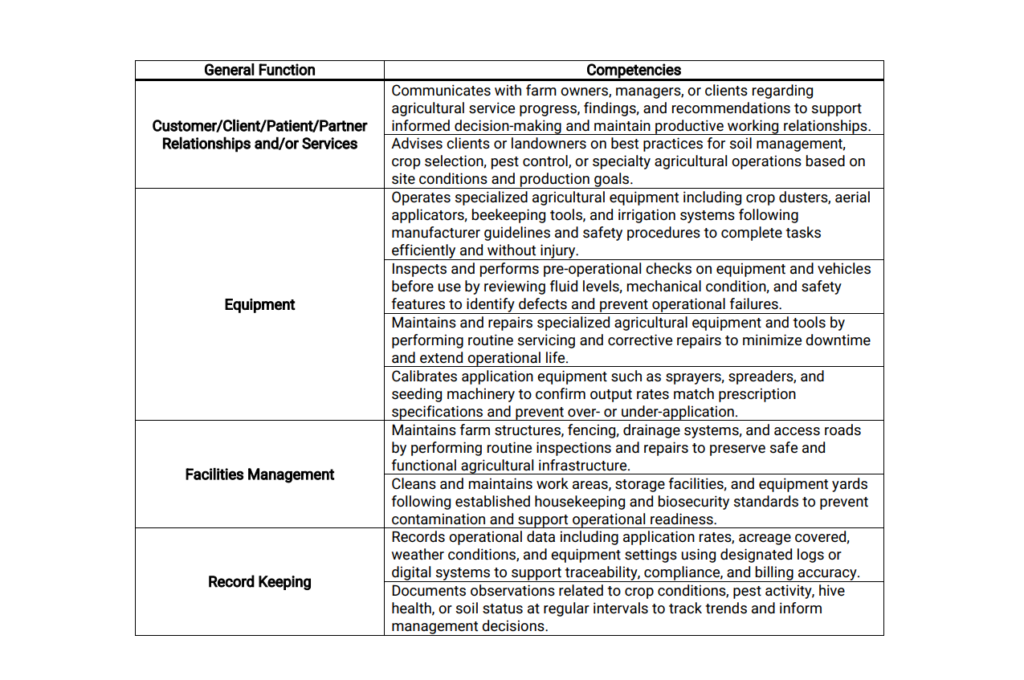
Education and training provider-facing occupation profiles offer more detailed information that can support curriculum design and alignment (see an example for Agricultural Equipment Operators below).
Credential Pathway Maps
Credential pathway maps extend this work at a systems level. They highlight existing regional education and training assets and reveal where gaps remain in meeting labor market demand. For learners and career counselors, these maps provide clarity on the next steps in education and career progression. For education and workforce partners, they offer actionable insights to support articulation agreements, program alignment, and more responsive pathway design, ultimately helping more learners build the competencies needed to succeed in high-demand careers.
While these resources alone will not ensure that workers transition into higher-quality roles, they provide local workforce development systems with the foundation to guide jobseekers toward better opportunities and to build the supports and partnerships necessary to help them get there. For example, through MAFSWAI, partners identified the need for more critical supports, such as English language learning, supports offered in Spanish, housing, transportation, childcare, and with internet/technology access prior to enrolling in career pathways training programs.
Other Critical Career Pathways Tools
Employers, workers, and educational institutions are also increasingly aligning on skills-based hiring, rapidly evolving job requirements, and a growing emphasis from funders and the federal government alike on incremental, shorter-term credentials that build upon each other over time. These responsive, flexible, and worker and learner-centered tools are more important now than ever and can also support effective career pathways systems and programs. Other tools beyond career and credential pathway maps and occupational profiles exist to translate this same competency-driven approach into curriculum design, credentialing, and credit for prior learning, ensuring workforce systems are aligned with real career pathways and support equitable advancement.
Competency-Based Curriculum Maps
Mapping occupational profiles to curricular outcomes is a method to ensure that credentials truly prepare learners for specific careers, and to identify opportunities to award credit for prior learning. This process begins with a detailed review of program curricula, including learning outcomes, content areas, assessments, and rubrics. Insights from this review are then used to build competency profiles for each program. These profiles are not developed in isolation. They are validated and refined through engagement with faculty and program designers, often through focus groups, to ensure they accurately reflect both instructional intent and real-world application. Once finalized, the profiles can be compared to occupational competency requirements, enabling a clear gap analysis between what education provides and what employers need.
Credit for Prior Learning Frameworks
Credit for Prior Learning Frameworks (or Recognition of Prior Learning) are a critical tool that recognize and validate learning, regardless of how or where that learning was acquired. That recognition can translate into awarded credit, creating a faster and more efficient path to a credential. Southwestern Oregon Community College (SWOCC) engaged CSW to enhance workforce development outcomes by implementing a Credit for Prior Learning (CPL) framework. This initiative was designed to attract and support local adult learners by awarding credit for non-academic learning and experience and providing those learners with pathways to new careers. SWOCC also hoped to boost SWOCC enrollment and prepare a worker pipeline for local industries, including manufacturing, healthcare, and hospitality. Through competency evaluations, gap analyses, and curriculum mapping, the project provided SWOCC faculty with tools leading to the recognition of prior learning. The result of the work was a process and methodology for awarding credit for workforce programs and a Credit for Prior Learning Implementation Framework.
Regional Educational Asset Maps
Regional Educational Asset Maps can support learners in developing a customized educational pathway to developing needed competencies, especially for new and emerging occupations. Lightweight Innovations For Tomorrow (LIFT) engaged CSW to lead regional stakeholders in an educational pathway mapping process for three emerging smarter manufacturing technologies: Digital Twin, Advanced Analytics, and Robotics. As part of this work, CSW developed asset maps to identify smarter manufacturing curricula to help Flint residents identify where they could access training to develop emerging competencies.
While food system workers continue to face real barriers, long hours, racial inequities, documentation challenges, and limited access to upskilling, the tools described here offer a powerful starting point. When thoughtfully designed and tailored to the needs of specific populations and regions, career and credential pathway tools do more than inform. They open doors and help individuals see new possibilities, make informed choices, and take concrete steps toward better opportunities. At the same time, they create a shared foundation for collaboration across workforce and postsecondary partners, aligning efforts to ensure that more people not only see a path forward, but are supported every step of the way.
Additional Resources
Many organizations have implemented successful career pathways and innovative approaches to advancing their success through the development of beneficial tools. To learn more about career pathways and related supports, CSW’s career and credential pathways work or Michigan Food System Initiatives, or our teams, please see the following brief list of resources.
- U.S. Department of Labor WorkforceGPS Career Pathways Toolkit: An Enhanced Guide and Workbook for System Development
- National Career Pathways Network
- Credential As You Go
- CSW’s Career and Credential Pathways Work
- CSW’s Michigan Food System Initiatives
- CSW’s Professionalizing the Direct Care Workforce: Developing Competency-Based Credentials
Learn more about CSW’s Competencies & Credentials Team
Learn more about CSW’s Research & Evaluation Team
If you have any questions or want to talk through our work or how our tools could advance your programs, please reach out to us at info@skilledwork.org.

Meet the Author
Megan Elyse Williams
Megan Elyse Williams is the Director of Research and Evaluation at CSW. Her current work includes supporting research and evaluation activities at CSW, as well as the staff engaged in them, and ensuring CSW’s research and evaluation methodologies and activities are current, ethical, and culturally responsive.

Meet the Author
Melissa Goldberg
Melissa Goldberg is the Director of Competencies & Credentials, leading CSW’s portfolio of work focused on expanding the use of competencies and non-degree credentials within learning and talent management systems to increase economic mobility for low-wage workers and address racial disparities.
Comments are closed.