
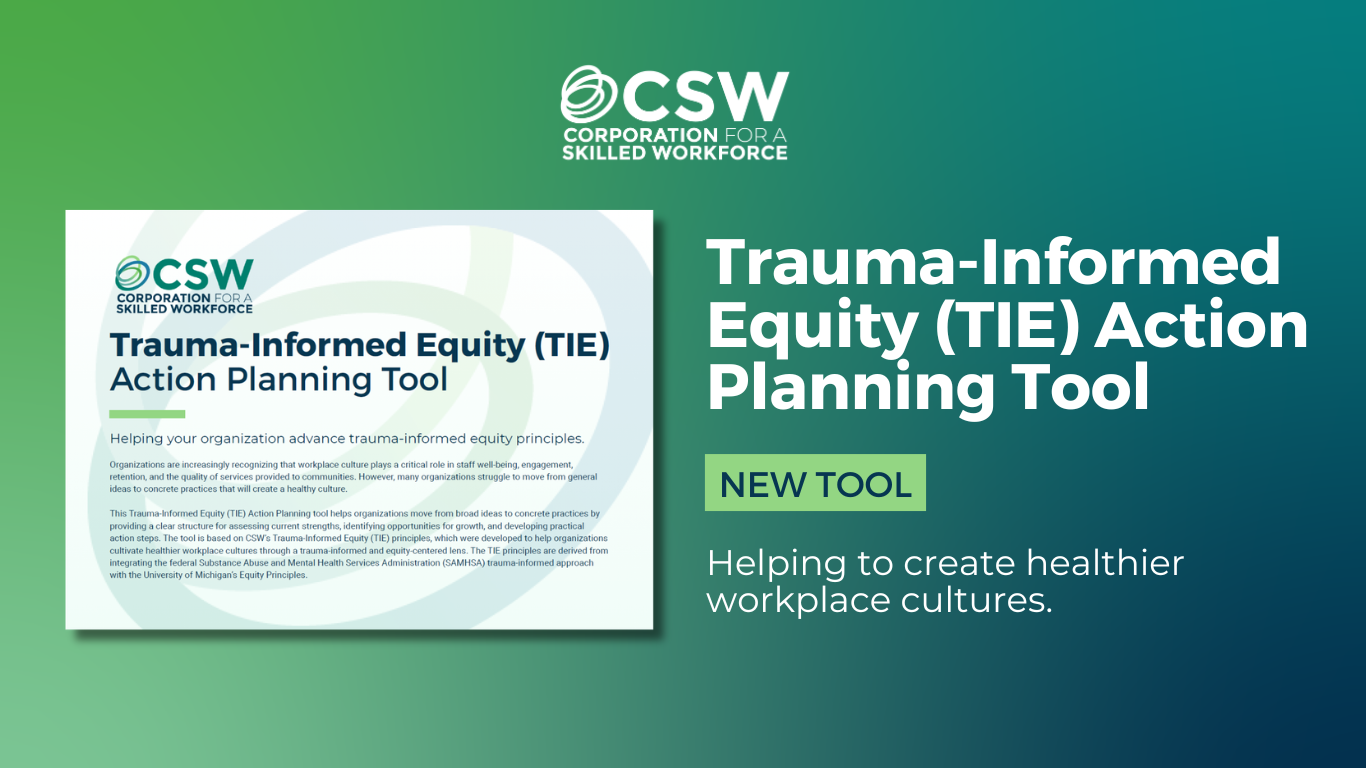
Organizations increasingly recognize the importance of creating workplace cultures where staff feel safe, valued, connected, and supported, yet many organizations struggle to identify specific policies and practices that achieve these cultural goals. While training and professional development can build awareness and inspire new ideas, organizations often need practical tools and structured processes to translate learning into meaningful action. To help organizations move from awareness to action, CSW developed the Trauma-Informed Equity (TIE) Principles and the accompanying TIE Action Planning Tool.
CSW’s TIE Principles provide a practical roadmap for organizational culture change. The six principles are mutually reinforcing: safety builds trust, trust enables empowerment, and empowerment fosters belonging. Together, they provide organizations with a shared framework for understanding, assessing, and strengthening the conditions that support healthier, more resilient, and more equitable workplaces.
- S = Safety, Acknowledgement, Respect, & Structured Interaction
- T = Trust & Transparency
- E = Empowerment, Voice, Choice, & Flexibility
- P = Peer Support & Belonging
- C = Collaboration & Mutuality
- C = Cultural Humility & Critically Engaging Difference
Reviewing the TIE principles at a high level is the first step. The TIE Action Planning Tool then helps teams translate those principles into everyday practices, policies, and culture change.
CSW’s TIE Action Planning Tool
The TIE Action Planning Tool provides a roadmap for translating the TIE principles into concrete, actionable steps that are customized to help your team and organization become more trauma-informed and resilience-building. CSW recommends working through one TIE principle at a time and establishing a regular cadence for completing the action plans for all six principles.
There are four steps to the TIE Action Planning Tool:
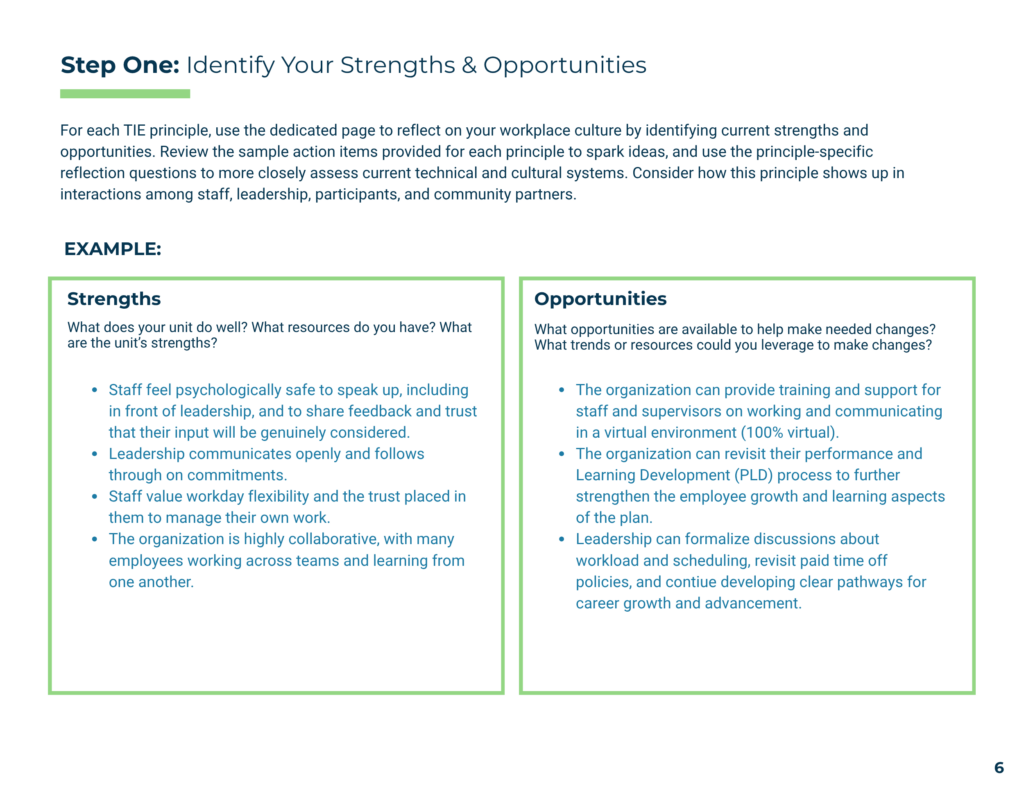
Step One: Identify Your Strengths & Opportunities
Choose one TIE principle and reflect on your team’s current strengths and opportunities for growth. Where is your team already putting this principle into practice? What strengths and resources can you build upon? What opportunities exist to deepen or expand implementation? This intentional reflection helps teams recognize what is working well (and why), while also identifying realistic opportunities for growth. Starting from a strengths-based rather than a deficit-based perspective builds momentum and increases buy-in. Gallup research shows that people are more engaged and motivated when they can identify and build on existing strengths, making it easier to sustain meaningful change over time.
Step Two: Prioritize Your Goals with the SMARTER Framework
Once you have brainstormed strengths and opportunities, decide what matters most. Rather than trying to address everything at once, prioritize two actionable goals that your team can realistically begin implementing right away.
The two goals should reflect one technical and one cultural change. Technical goals focus on the formal systems that guide how work gets done. These strategies often involve developing or revising policies, procedures, tools, or organizational processes. Cultural goals focus on everyday behaviors, relationships, and norms that shape the workplace experience. These strategies help create an environment where people feel safe, respected, connected, empowered, and supported.
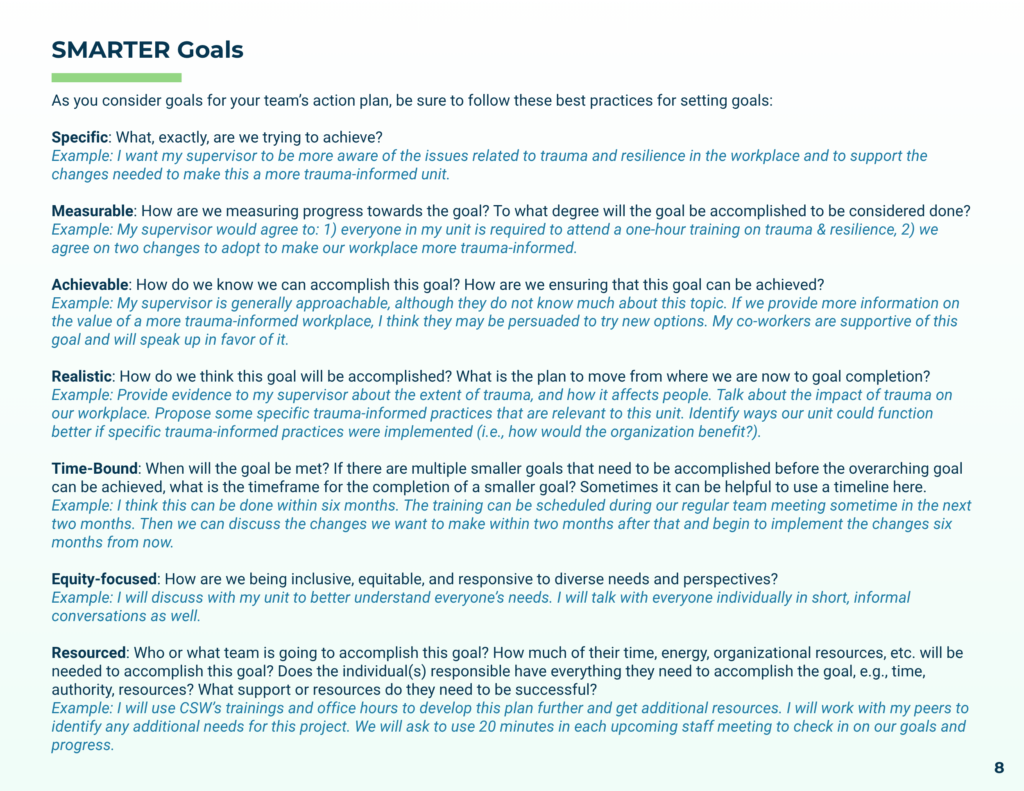
Use the SMARTER framework to refine each goal. A structured framework like SMARTER helps transform ideas and intentions into clear, actionable next steps that can be implemented, evaluated, and sustained over time.
- Specific: What, exactly, are we trying to achieve?
- Measurable: How are we measuring progress and what does success look like?
- Achievable: How do we know we can accomplish this goal? How are we ensuring that this goal can be achieved?
- Realistic: Is this goal realistic given our current capacity and resources?
- Time-bound: When will this goal be accomplished? If there are smaller milestones along the way, what is the timeline for each?
- Equity-focused: How will we ensure this goal is inclusive, equitable and responsive to diverse needs and perspectives?
- Resourced: Who is responsible for this work, what resources are needed, and what additional supports may be needed for success?
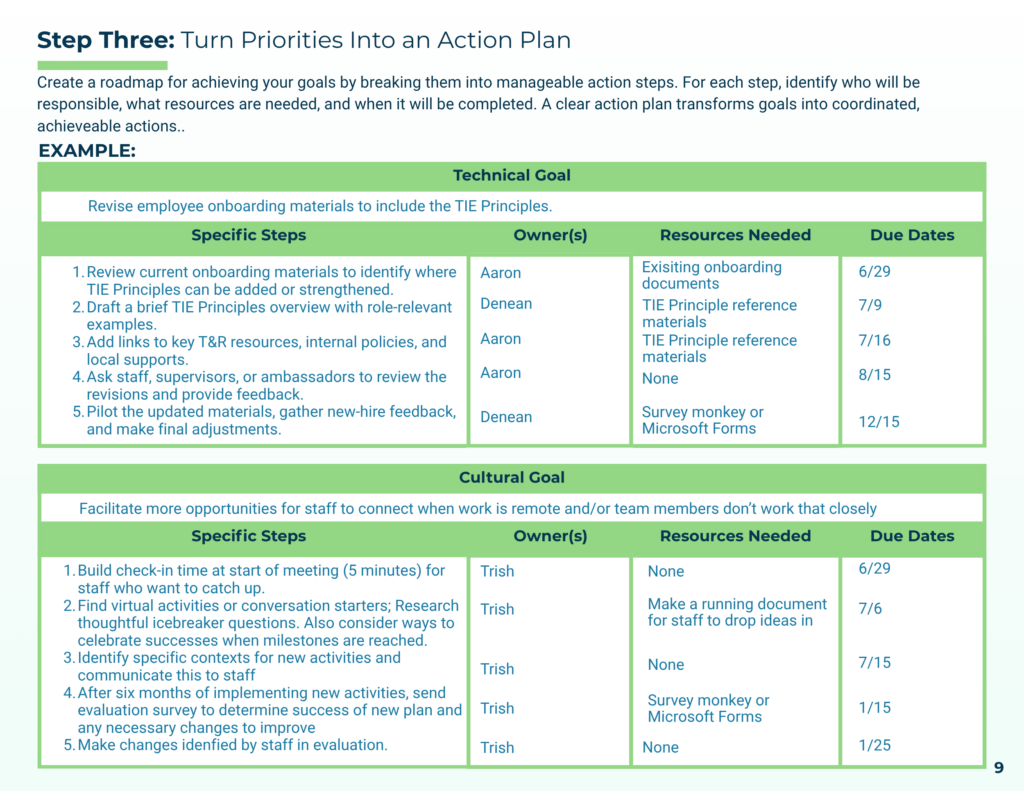
Step Three: Turn Priorities into an Action Plan
Create a roadmap for achieving your goals by breaking them into manageable action steps. For each step, identify who will be responsible, what resources are needed, and when it will be completed. A clear action plan transforms goals into coordinated, achievable actions.
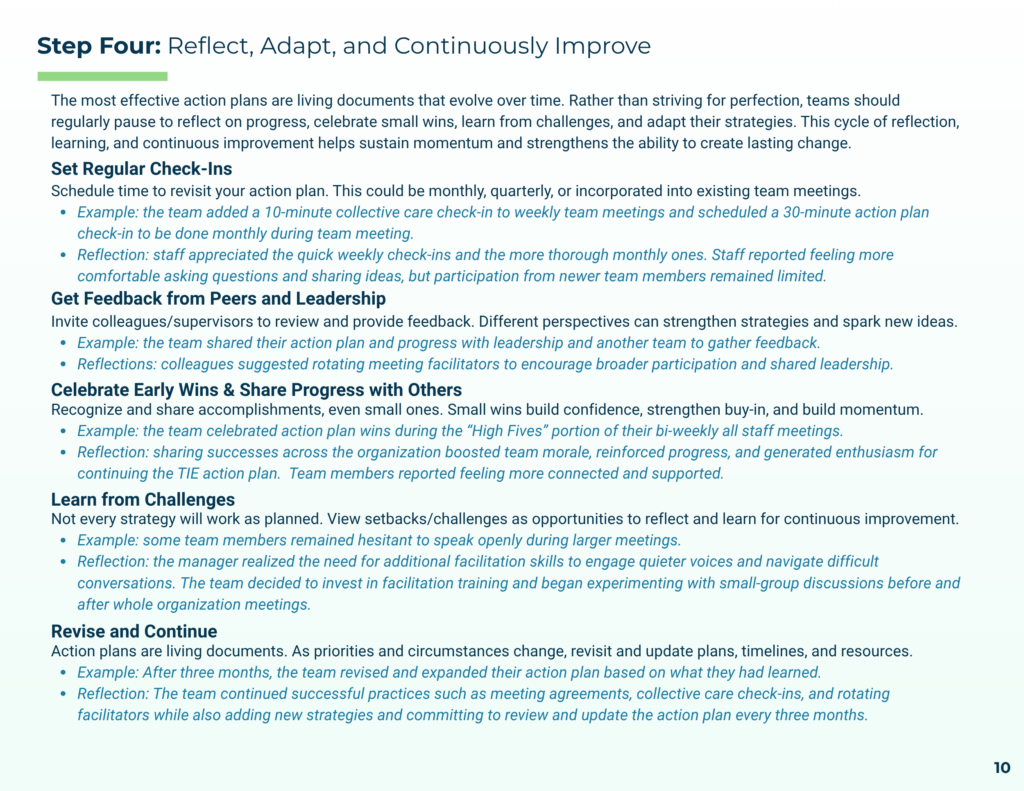
Step Four: Reflect, Adapt, & Continuously Improve
The most effective action plans are living documents that evolve over time. Rather than striving for perfection, teams should regularly pause to reflect on progress, celebrate small wins, learn from challenges, and adapt their strategies. This cycle of reflection, learning, and continuous improvement helps sustain momentum and strengthens your team’s ability to create lasting change.
Michigan NEAR’s Journey Toward More Trauma-Informed State Systems
In 2018, the State of Michigan committed to raising awareness of Adverse Childhood Experiences (ACEs) across state agencies when it instituted the Michigan NEAR (Neuroscience, Epigenetics, Adverse Childhood Experiences, Resilience) Collaborative. After six years of training state staff on ACEs, the NEAR Collaborative wanted to spur deeper, systemic change that would move beyond trauma-informed staff to trauma-responsive services, programs, and state agencies. Michigan NEAR’s parent agency, the Department of Health and Human Services, hired CSW to provide additional training and coaching to help Michigan state agencies cultivate trauma-informed systems.
CSW led a 16-month initiative from June 2024 through September 2025 that included monthly training sessions to deepen content knowledge, action labs to practice behavior change, along with coaching and office hours support development and implantation of action plans within a subset of “ambassadors” from the Michigan NEAR Collaborative. Ambassadors were from the Department of Education (MDE), Department of Health and Human Services (DHHS), and Department of Labor and Economic Opportunity (LEO).
Examples of MI NEAR Ambassadors TIE Action Planning Process
The MI Ambassadors found the action planning process with CSW extremely helpful in breaking down learnings and customizing implementation strategies for their units.
Implemented the Strengths and Opportunities Exercise. The MI Ambassadors went through each of the principles and answered the following questions.
- How do our current practices, services, programs, supervision, and policies already reflect these principles?
- Example: One unit recognized that they offer flexible work schedules and began meetings with quick check-ins.
- How can we further integrate each of these principles into all aspects of our unit/team?
- Example: This team decided to further embed TIE principles into their meeting facilitation by creating and adhering to meeting agreements that foster a safe space for honest discussion between leaders and staff.
Developed 2-3 Priority Goals using the SMARTER Framework. After completing the Strengths and Opportunities exercise, MI Ambassadors reviewed common themes and identified areas for their specific units where they could deepen implementation of the TIE principles. Using the SMARTER framework helped the Ambassadors translate broad aspirations into specific goals with clear next steps. Common priority areas across units included strengthening organizational communication, increasing leadership engagement and buy-in, and fostering psychologically safe and collaborative team cultures.
Turned Goals into Detailed Action Plans. Once goals were identified, Ambassadors developed implementation plans that outlined specific steps, staff assignments, resources needed, and a timeline for completion.
Shared progress, gathered feedback, and maintained accountability. Over several months, MI Ambassadors had chances to present, discuss, and refine their action plans with the larger group. These peer-review sessions created space for valuable feedback, coaching, and collaborative problem-solving, helping Ambassadors strengthen their strategies and overcome implementation challenges. Ambassadors found it valuable to learn from one another’s efforts, celebrate successes, and discuss obstacles openly in a safe space. Regular opportunities to revisit goals, reflect on progress, and adjust approaches helped sustain momentum, strengthen accountability, and encourage continuous improvement.
MI Ambassador Wins as a Result of Their TIE Action Plans
Strengthened organizational communication by using the TIE principles to create a shared language and common understanding, establishing a process for reviewing internal and external communications through a TIE lens, and improving transparency across teams and leadership through regular updates on unit priorities, decisions, and upcoming changes as well as dedicated time for staff questions and feedback.
Increased leadership engagement and accountability by creating safe opportunities for staff to raise concerns, provide feedback, and debrief, while leaders improved transparency by communicating decision-making processes, timelines, and the rationale behind unit changes.
Fostered psychologically safe and collaborative team environments by integrating TIE facilitation practices into staff meetings, including team values, working agreements, collective care check-ins, and grounding exercises. Leaders modeled self and collective care by discussing workload, encouraging breaks, sharing their own self-care strategies, and regularly checking in on staff capacity and well-being.
Promoted sustainable and supportive workplace practices by embedding one TIE principle at a time into staff meetings, manager meetings, and biannual retreats, while reducing unhealthy urgency through consistent team norms, clear expectations, and tools that supported workload prioritization and sustainability.
The MI NEAR Collaborative’s experience highlights three key lessons for organizations seeking to move from awareness to action:
- Acknowledge that change takes effort. This is not easy work. Limited time, competing priorities, lack of leadership support, and uncertainty about where to begin are all real challenges. A strong action planning process recognizes these barriers while helping teams take practical, achievable steps towards becoming more trauma-informed and equity-focused.
- Start with small, achievable wins. While long-term goals are important, they can also feel overwhelming. Lasting change begins with small, consistent actions. The Power of Small Wins is that they build momentum, increase confidence, demonstrate progress, and help teams stay motivated over time.
- Create structures that support action. Learning and awareness alone do not create change. Tools, processes, and dedicated opportunities for planning, reflection, and accountability help bridge the gap from intention to implementation.
Ultimately, action planning is not about creating a perfect document. It is about creating a practical roadmap for change. The most effective action plans are practical, flexible, collaborative, and tailored to the unique needs of teams or units. Use the CSW TIE Action Planning tool as a starting point, adapting it to fit your goals, culture, and capacity.
Most importantly, approach the process with patience, curiosity, and a growth mindset. Meaningful systems change does not happen all at once. It happens through small, intentional actions that build trust, strengthen relationships, and create lasting change over time.

Meet the Author
Patricia Maguire
Patricia is a Senior Policy Associate with CSW’s Trauma and Resilience at Work team, working to advance workplaces and workforces that are culturally responsive, trauma-informed, resilience-building, and supportive of mental well-being.
Comments are closed.