
Picture this: a student walks into a community college advisor’s office wanting a better job, a path forward, and is willing to put in the work. But that student needs to know the program they’re about to commit time and money to will actually lead to a job that offers a family-supporting wage.
This is not an unreasonable ask. In fact, it’s exactly the right question: as a student, how can I know if I’m investing in the right program? Colleges across the country are working harder than ever to provide better guidance and data for students making these big decisions. One of the most effective tools in this process is labor market information, or LMI.
How Colleges Can Put LMI to Work
LMI is any data about a region’s labor force, labor market, or workforce development system. You might also see LMI called workforce data, job market data, labor market intelligence, and other similar terms. It provides quantitative and qualitative evidence about which jobs are growing, what skills employers are hiring for, how much different occupations pay, and where regional demand is concentrated. At its best, it can provide colleges a window into what the labor market needs not just today, but in the years ahead.
However, knowing that LMI exists and knowing how to effectively use it are two different experiences. Many colleges have access to data, but far fewer have developed a system for incorporating LMI into how they make decisions on which programs to offer, how advisors work with students, and how to build partnerships with employers.
When colleges don’t have a clear, data-informed view of regional workforce demand, the consequences ripple out in real ways. Without LMI, programs may not align with where the jobs are. Students may invest time and money into credentials that don’t open the doors they expected. And institutions can miss opportunities to serve communities that most need access to quality career pathways.
A New LMI Guide to Help Colleges More Effectively Use Data
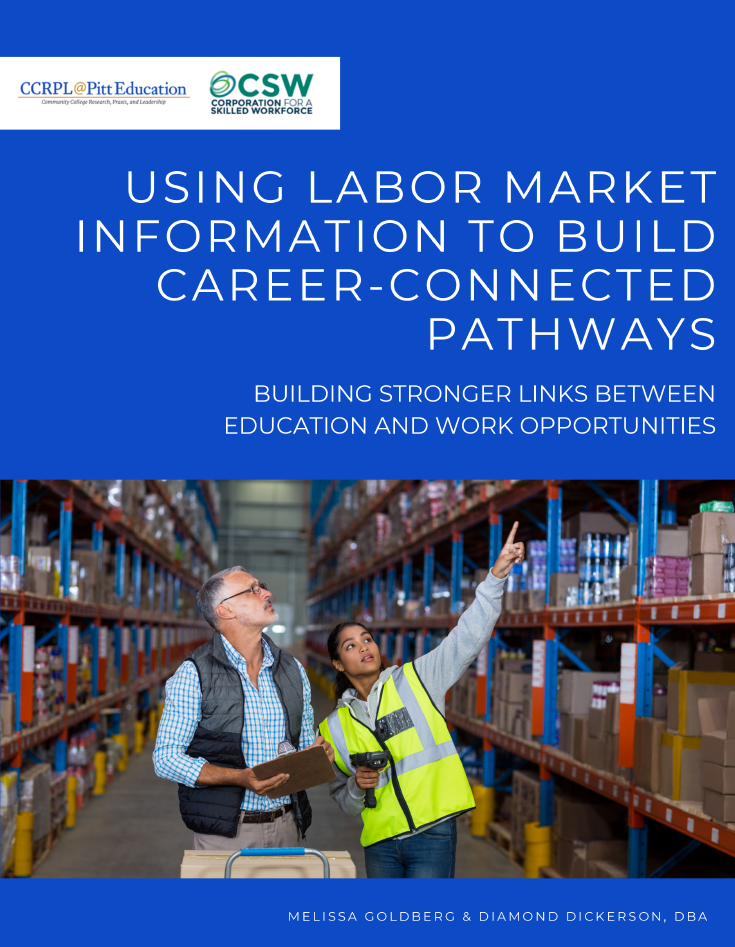
These challenges were the impetus in creating Using Labor Market Information to Build Career-Connected Pathways.
This guide isn’t an academic exercise but rather is grounded in what’s working in the field. It identifies the strategies, practices, and approaches that colleges have been putting to use. Organized around three core areas of pathway design and implementation, it’s written to help institutions move beyond ad-hoc data use toward something more systematic and sustainable; whether the institution is advancing a comprehensive pathway strategy or targeting a specific phase of development.
The guide may be useful for:
- Workforce directors trying to make the case for a new program
- Advisors looking for ways to ground career conversations in data
- College leaders trying to build more coherent institutional strategies
The guide provides practical strategies for:
- Integrating LMI into program development and review
- Strengthening employer partnerships through data
- Making LMI accessible and actionable for advisors and faculty
- Building more transparent, equitable pathways to quality jobs
The Challenge of Moving from Data to Action
Interest in LMI is growing across the higher education and workforce development space. But many colleges still struggle to move from isolated, one-off uses of data to a cohesive, institution-wide approach. LMI might get used by one program director to justify a curriculum change, but it doesn’t make its way into advising conversations. Or it gets pulled together for a grant report and then sits on a shelf. Or it’s accessible to senior administrators but doesn’t reach the faculty and advisors who are closest to students.
The guide is clear on this point: “LMI is most powerful when it is integrated, contextualized, and acted upon. No single data source provides all the answers.” Building a culture of data-informed decision-making, one that spans programs, advising, institutional strategy, and employer engagement, takes intentional effort. It requires people, processes, and sometimes technology. It requires asking not just “what do the data say?” but “who needs to see this, and how does it change what we do?”
How Colleges Are Using LMI
This year, CSW is partnering with the University of Pittsburgh School of Education’s Community College Research, Praxis, and Leadership team (CCRPL) on a project focused on advancing career-connected pathways: a framework for making career integration a sustainable, scalable part of how colleges operate.
As part of that work, we are supporting a community of practice made up of seven community college teams from across the country. Each team came to this work with a commitment to building stronger data practices. They are united by a shared goal: helping every learner find a pathway to a quality job. What sets these colleges apart is that they aren’t just talking about using data; they’re putting it into practice in creative, strategic, and real-world ways. Through the community of practice, they’re pushing that work further, exchanging ideas with peers on new approaches to using LMI and finding new audiences for their findings.
Piedmont Technical College is a case in point. They are building dashboards that give advisors real-time labor market data, helping ground career conversations in regional economic trends. These dashboards include information on career paths, job requirements, physical demands, hiring outlook, and local employers. Piedmont Tech also uses LMI to strengthen employer partnerships by bringing data on skills gaps and in-demand credentials to advisory board and one-on-one meetings. In addition, the college uses workforce data to refine existing programs and develop new ones that address local market needs.
Community colleges are doing some of the most important work in our country, connecting people to economic opportunities, often people for whom other doors haven’t been open. The vision we’re working toward is one where colleges use LMI to create, in the words of the guide, “transparent, relevant, and responsive pathways that help students see where they are going, understand how to get there, and achieve meaningful economic mobility.”
We’re excited to share this resource, and even more excited about the possibilities ahead as more colleges embrace this kind of data-informed approach.
Explore the full resource guide: Using Labor Market Information to Build Career-Connected Pathways

Meet the Author
Melissa Goldberg
Melissa Goldberg is the Director of Competencies & Credentials, leading CSW’s portfolio of work focused on expanding the use of competencies and non-degree credentials within learning and talent management systems to increase economic mobility for low-wage workers and address racial disparities.
Comments are closed.