

Michigan’s food system is made up of a diverse number of industries that span the production-consumption lifecycle of food grown in Michigan—from the farm to processors and ultimately grocery stores and restaurants. Despite the importance of these industries, most workers face low wages, poor job quality, and limited opportunities for equitable, family-sustaining career advancement.
Over the years, CSW has researched employment patterns, wages and benefits, workforce demographics, occupational segregation, and future growth opportunities for Michigan’s food system to help policymakers, advocates, workforce professionals, and educators better understand where improvements are needed to expand economic mobility. This work has also focused on documenting where better career opportunities exist for workers in this field and how to get there. Please see more about our work and findings below.
The Michigan Agriculture and Food Systems Workforce Advancement Initiative (MAFSWAI) Project
Since 2021, CSW, with funding from the National Institute of Food and Agriculture from the U.S. Department of Agriculture, has led The Michigan Agriculture and Food Systems Workforce Advancement Initiative (MAFSWAI) in partnership with the Michigan Department of Labor and Economic Opportunity; the Institute of Agriculture Technology, Center for Regional Food Systems, and Migrant Student Services at Michigan State University; and Michigan Food and Farming Systems.
MAFSWAI seeks to help migrant and seasonal farmworkers (MSFWs) access the supports and skills needed to understand and access advanced and higher quality agriculture and food system employment opportunities, thereby supplying Michigan food growers, processers, and distributors with the workforce they need to fill critical jobs at all skill levels.
This work involves convening partners, conducting labor market information research, surveying and interviewing MSFWs and regional employers, as well as developing tools to support workers, employers, and educators in expanded awareness of these higher quality careers and how and where workers can receive the training and supports needed to access them.
Michigan Agriculture and Food Systems Workforce Advancement Initiative Career Pathway Maps
As part of this project, CSW updated the 2021 Food System Occupational Pathways in Michigan (documented below) and translated them into Spanish to increase their accessibility. The pathway maps provide employment statistics from 2023 and 2024, projected five-year growth, top skills requested in job postings for each job type, and other position requirements for six food system subsectors. Learners, workers, career counselors, and career navigators can use these maps to both identify accessible points of entry into food system careers as well as to understand which future opportunities exist to move into higher skilled, higher paying jobs aligned to their current role.
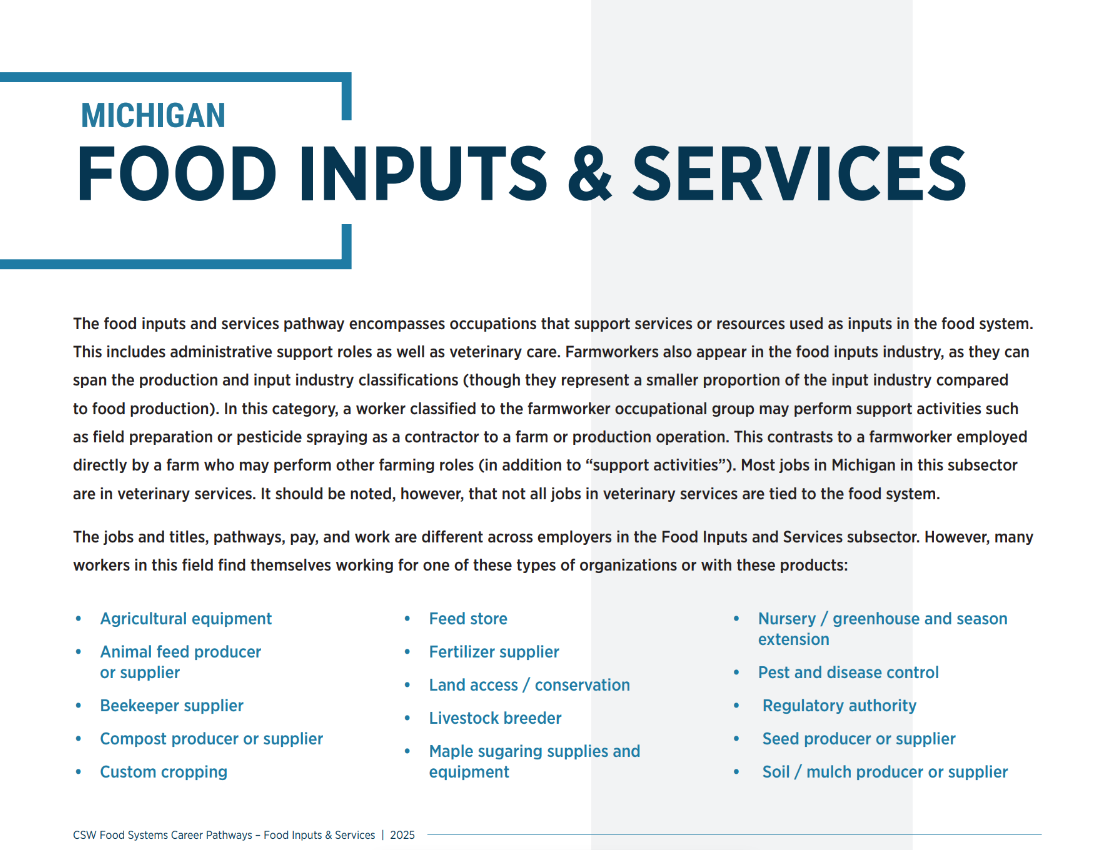
Food Inputs & Services
Download in English
Insumos Y Servicios Alimentos
Descargar en Español
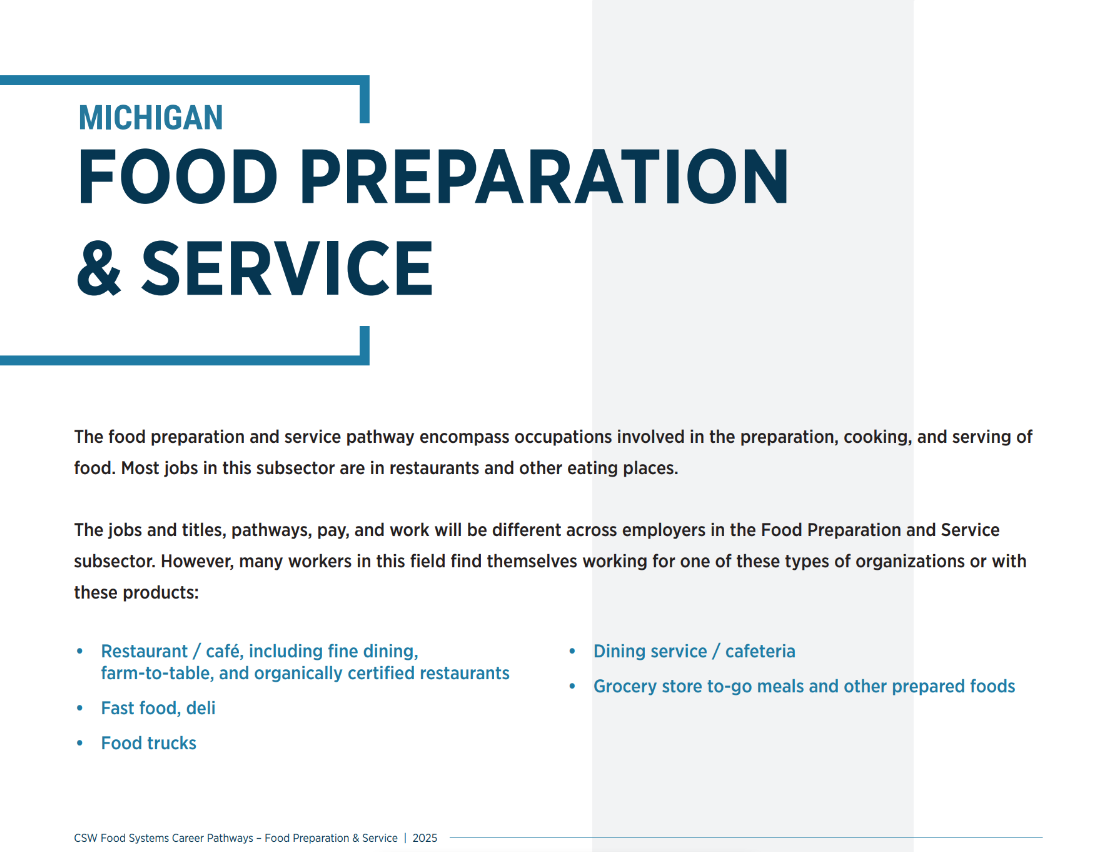
Food Preparation & Service
Download in English
Preparación Y Servicio De Alimentos
Descargar en Español
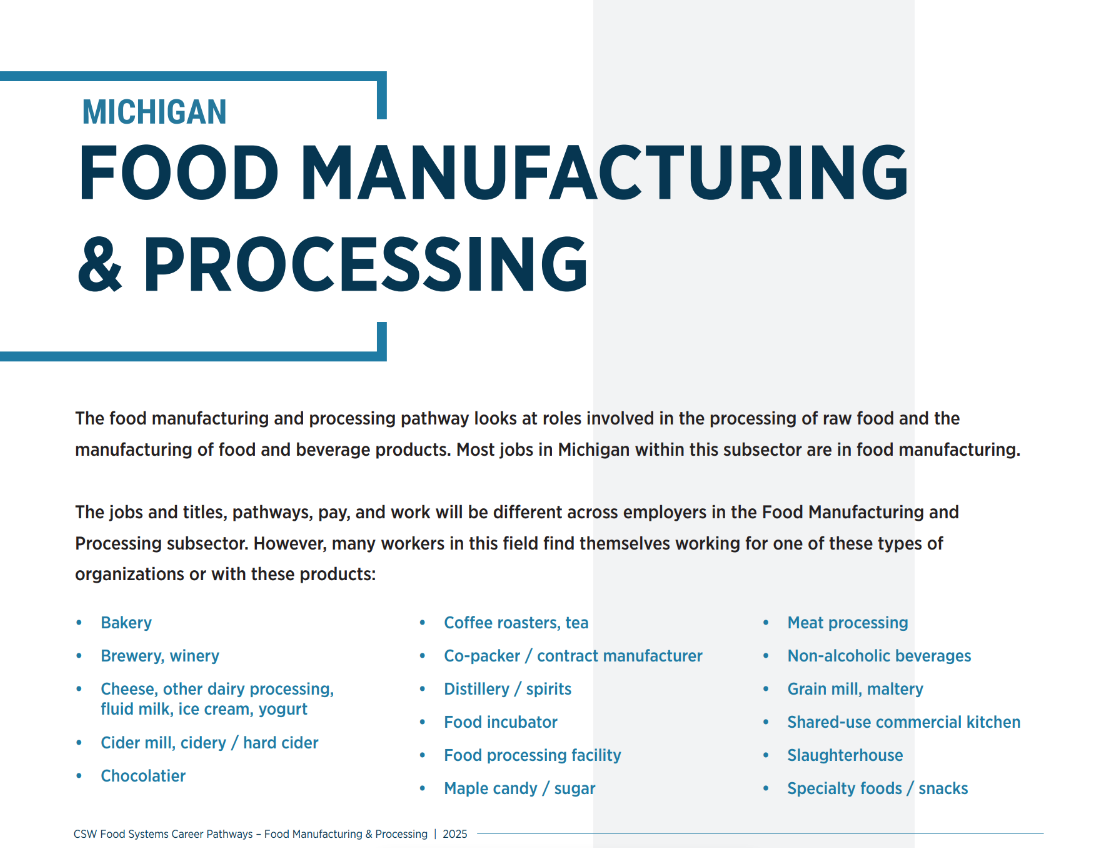
Food Manufacturing & Processing
Download in English
Manufactura Y Procesamiento De Alimentos
Descargar en Español
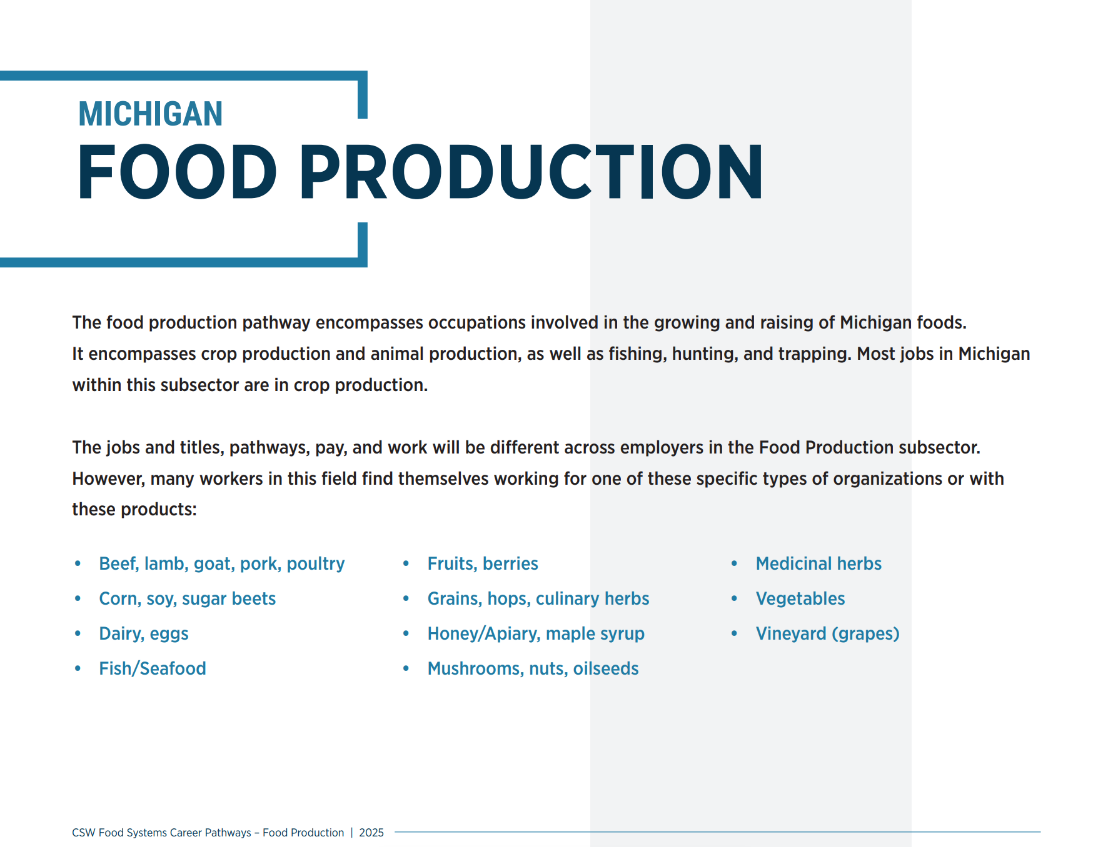
Food Production
Download in English
Producción De Alimentos
Descargar en Español
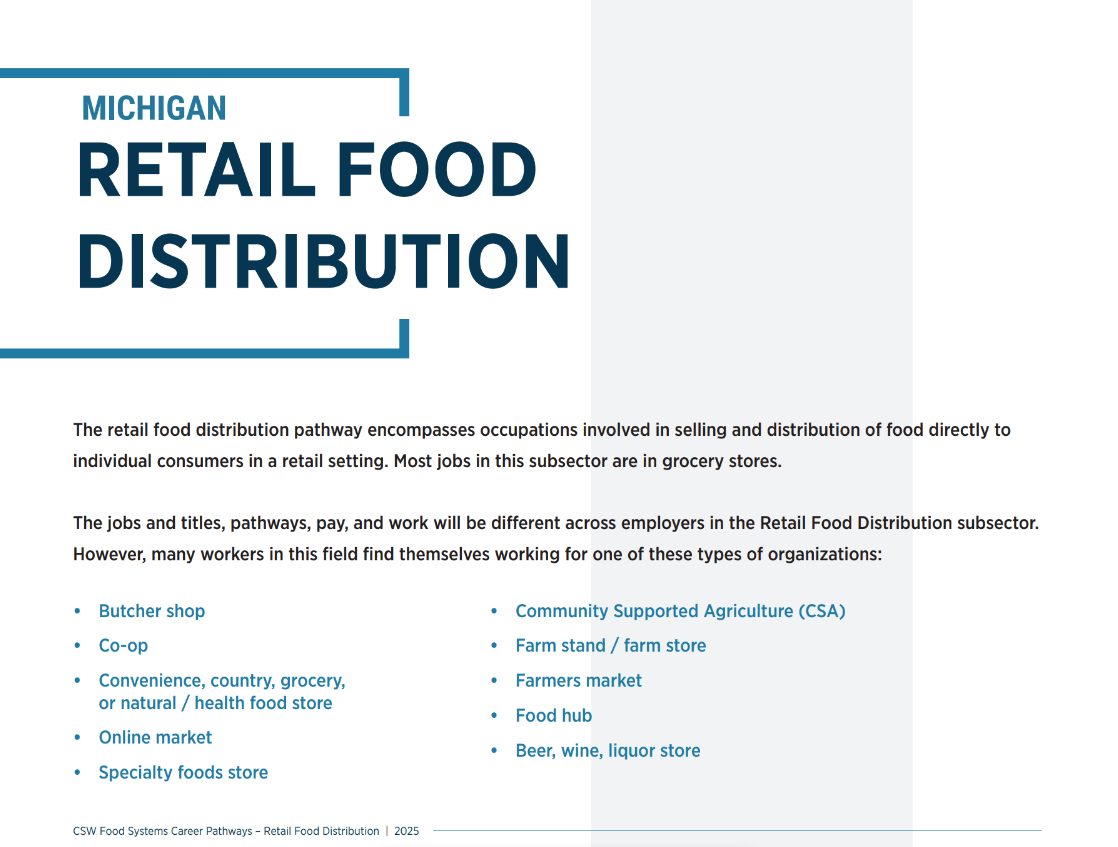
Retail Food Distribution
Download in English
Distribución Minorista De Alimentos
Descargar en Español
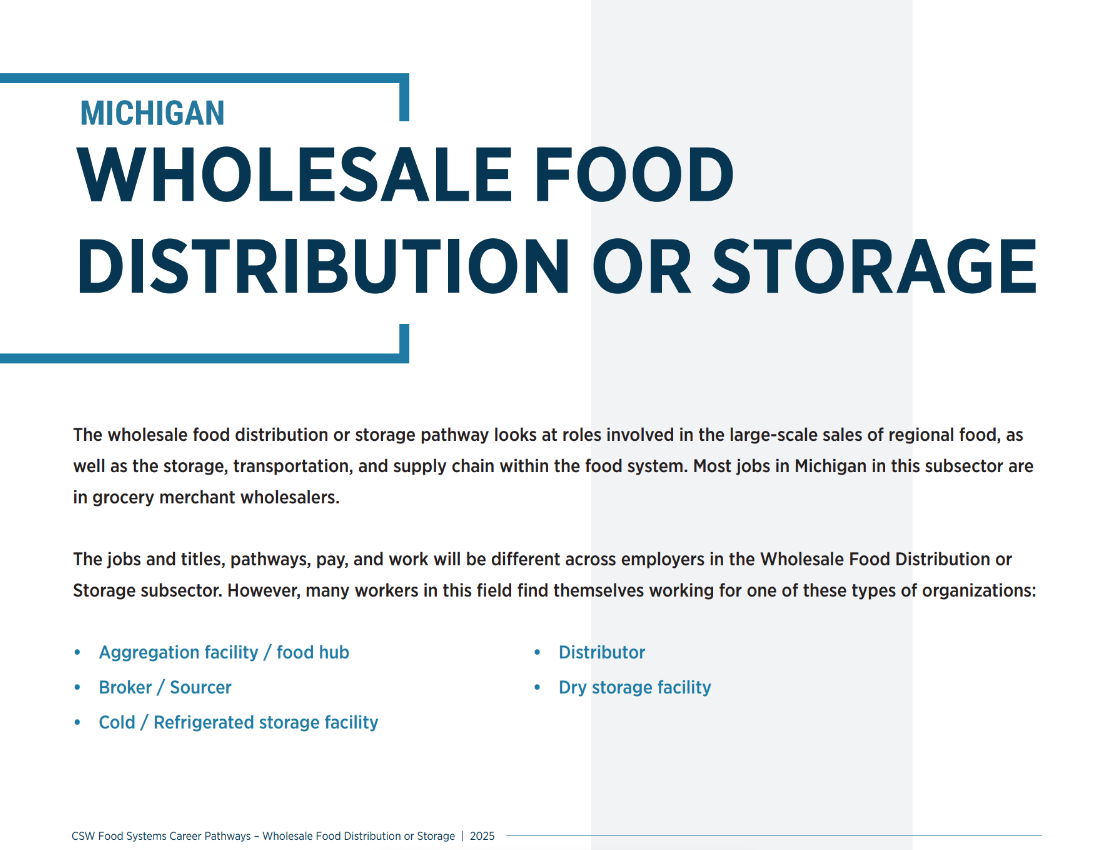
Wholesale Food Distribution or Storage
Download in English
Distribución O Almacenamiento De Alimentos De Mayoreo
Descargar en Español
Michigan Agriculture and Food Systems Workforce Advancement Initiative Occupational and Competency Profiles
CSW developed a set of occupational and competency profiles for 21 food system occupations. The occupational profiles provide general information on key food system roles and are provided in Spanish and English. They outline regional employers, credentials, experience levels, and wages to provide a comprehensive overview of what someone entering the role could expect. Food system learners and workers can also use these tools to not only understand future career opportunities aligned to their skills but as helpful resources in identifying and communicating to prospective employers the skills they have already developed from their current or past work.
The competency profiles provide a detailed outline of job functions and the skills needed for these roles. These profiles can be used by education, training, and workforce organizations to support curriculum development, career navigation, and employer hiring by providing clear, actionable occupational information.
Included Occupations:
- Agricultural Equipment Operators (Operadores de Equipos Agrícolas)
- Agricultural Workers (Trabajadores Agrícolas)
- Animal Breeders (Criadores de Animales)
- Animal Caretakers (Cuidadores de Animales)
- Bakers (Panaderos)
- Farmers, Ranchers, and Other Agricultural Managers (Agricultores, Ganaderos y otros Gerentes Agrícolas)
- Farmworkers and Laborers, Crop, Nursery, and Greenhouse (Trabajadores Agrícolas y Peones que Trabajan en Cultivos, Viveros e Invernaderos)
- First-Line Supervisors of Farming, Fishing, and Forestry Workers (Supervisores de Primera Línea de Trabajadores Agrícolas, Pesqueros y Forestales)
- First-Line Supervisors of Production and Operating Workers (Supervisores de Primera Línea de Trabajadores de Producción y Operación)
- First-Line Supervisors of Transportation and Material-Moving Machine and Vehicle Operators (Supervisores de Primera Línea de Transporte y de Máquinas de Movimiento de Materiales y Operadores de Vehículos)
- Food Batchmakers (Fabricantes de Lotes de Alimentos)
- Food Service Managers (Gerentes de Servicio de Alimentos)
- Laborers and Freight, Stock, and Material Movers (Trabajadores y Transportistas de Carga, Existencias y Materiales)
- Light Truck Drivers (Conductores de Camiones Ligeros)
- Occupational Health and Safety Specialists (Especialistas en Salud y Seguridad Ocupacional)
- Packaging and Filling Machine Operators and Tenders (Operadores y Encargados de Máquinas de Envasado y Llenado)
- Packers and Packagers (Envasadores y Empacadores)
- Pesticide Handlers, Sprayers, and Applicators, Vegetation (• Manipuladores, Rociadores y Aplicadores de Pesticidas para Vegetación)
- Separating, Filtering, Clarifying, Precipitating, and Still Machine Setters, Operators, and Tenders (Operadores, Encargados y Preparadores de Máquinas de Alambique, Separadoras, Filtradoras, Clarificadoras y Precipitadoras)
- Veterinary Assistants and Laboratory Animal Caretakers (Asistentes Veterinarios y Cuidadores de Animales de Laboratorio)
- Veterinary Technologists and Technicians (Tecnólogo y Técnico Veterinario)
MICHIGAN FOOD SYSTEM OCCUPATIONAL PROFILES
Download in English
PERFILES DE CARRERAS DEL SISTEMA ALIMENTICIO DE MICHIGAN
Descargar en Español
MICHIGAN FOOD SYSTEM COMPETENCY PROFILES
Download in English
Food System Occupational Pathways in Michigan
In 2020, with funding from the W.K. Kellogg Foundation and Michigan State University Extension, CSW and Michigan State University Center for Regional Food Systems released Food Systems Career Pathways in Michigan, which outlined accessible career opportunities and pathways in Michigan’s food system. The career pathway maps illustrate how food system employees change careers or move into higher skilled, higher paying jobs – and how associated businesses or workforce agencies can help individuals develop their careers. This report also includes employment statistics from 2019 and 2020, projected five-year growth, level of demand for each job type, and what educational programs are available for career advancement.
This resource is an overview of the jobs that exist, the skills and education required, and the respective wages for six food system subsectors:
- Food Production
- Food Inputs and Services
- Food Manufacturing and Processing
- Wholesale Food Distribution or Storage
- Retail Food Distribution
- Food Preparation and Service
The career pathway maps illustrate how food system employees change careers or move into higher skilled, higher paying jobs – and how associated businesses or workforce agencies can help individuals develop their careers. This report also includes employment statistics from 2019 and 2020, projected five-year growth, level of demand for each job type, and what educational programs are available for career advancement.
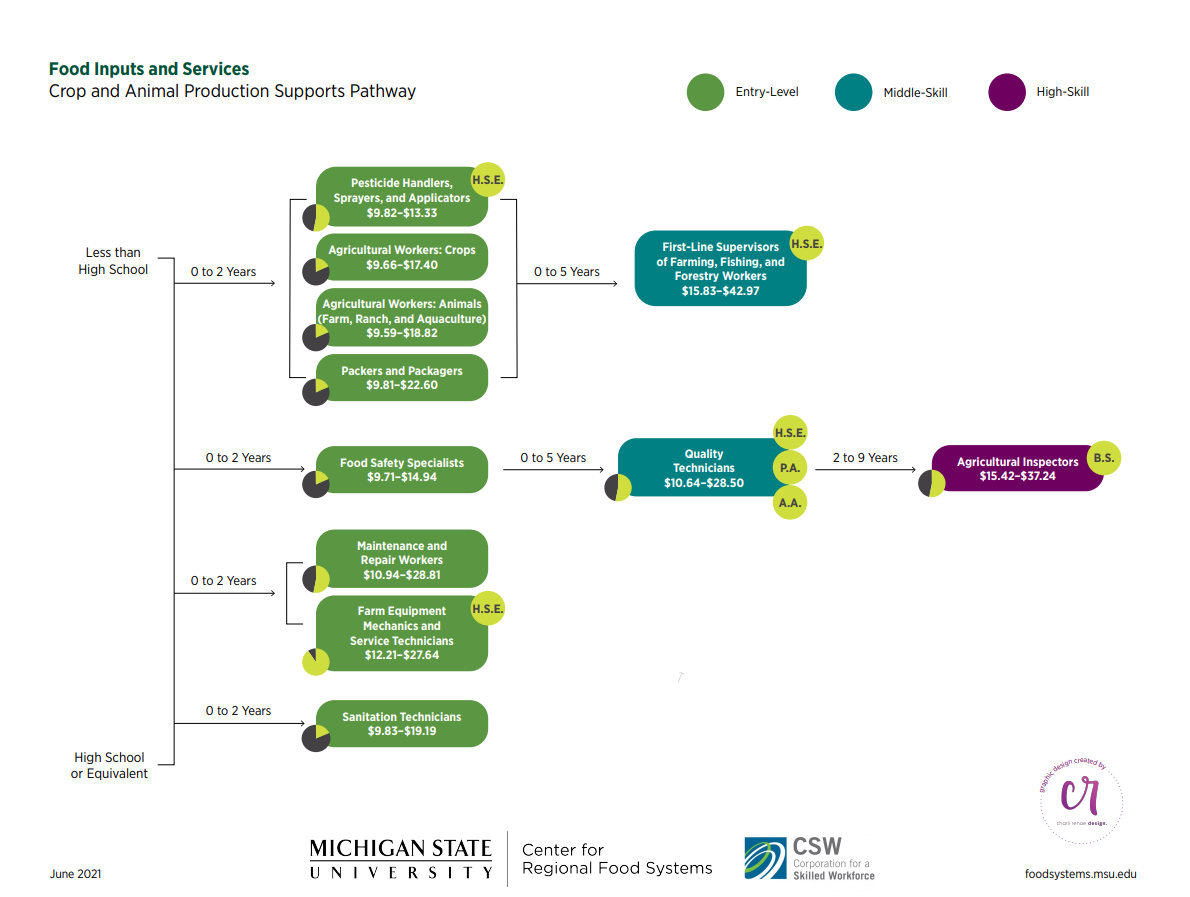
Food Inputs and Services Career Pathway Maps
Download in English
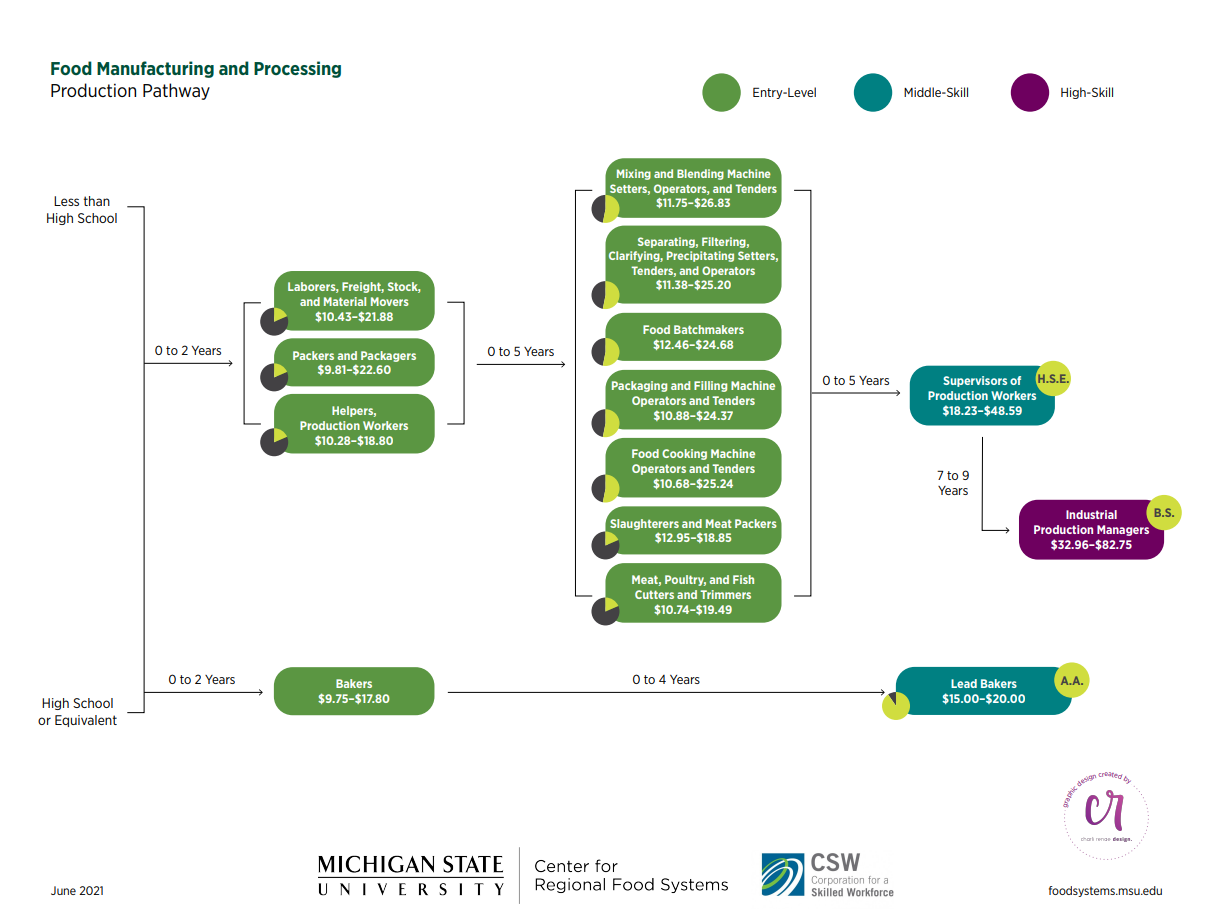
Food Manufacturing and Processing Career Pathway Maps
Download in English
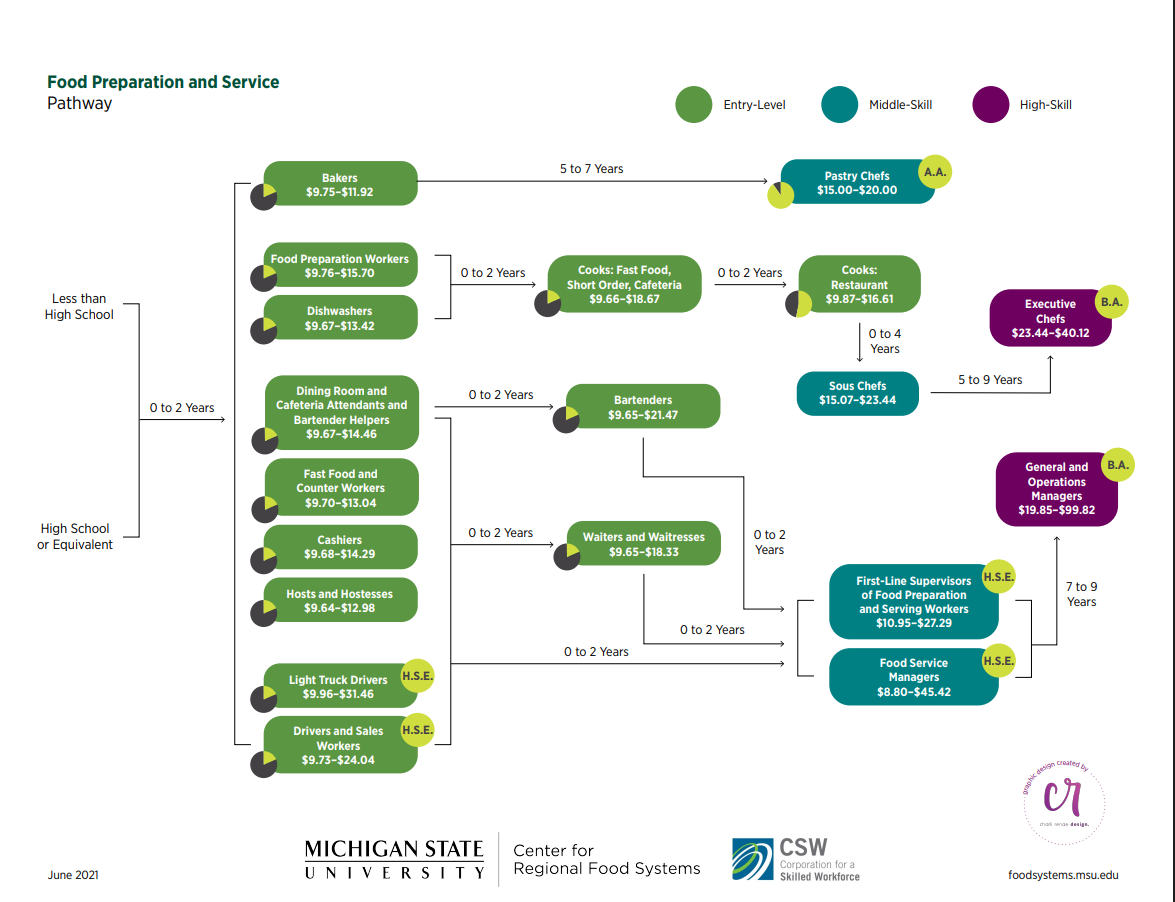
Food Preparation and Service Career Pathway Map
Download in English
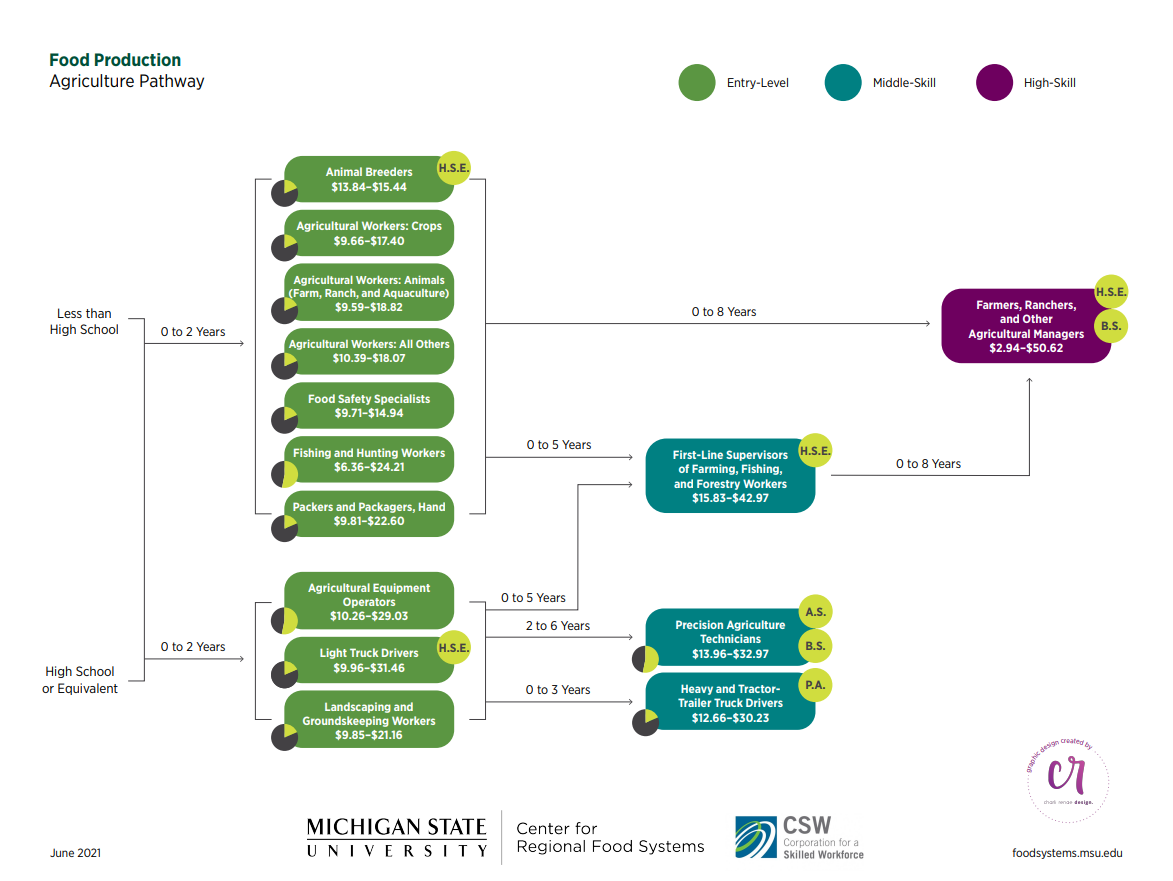
Food Production Career Pathway Maps
Download in English
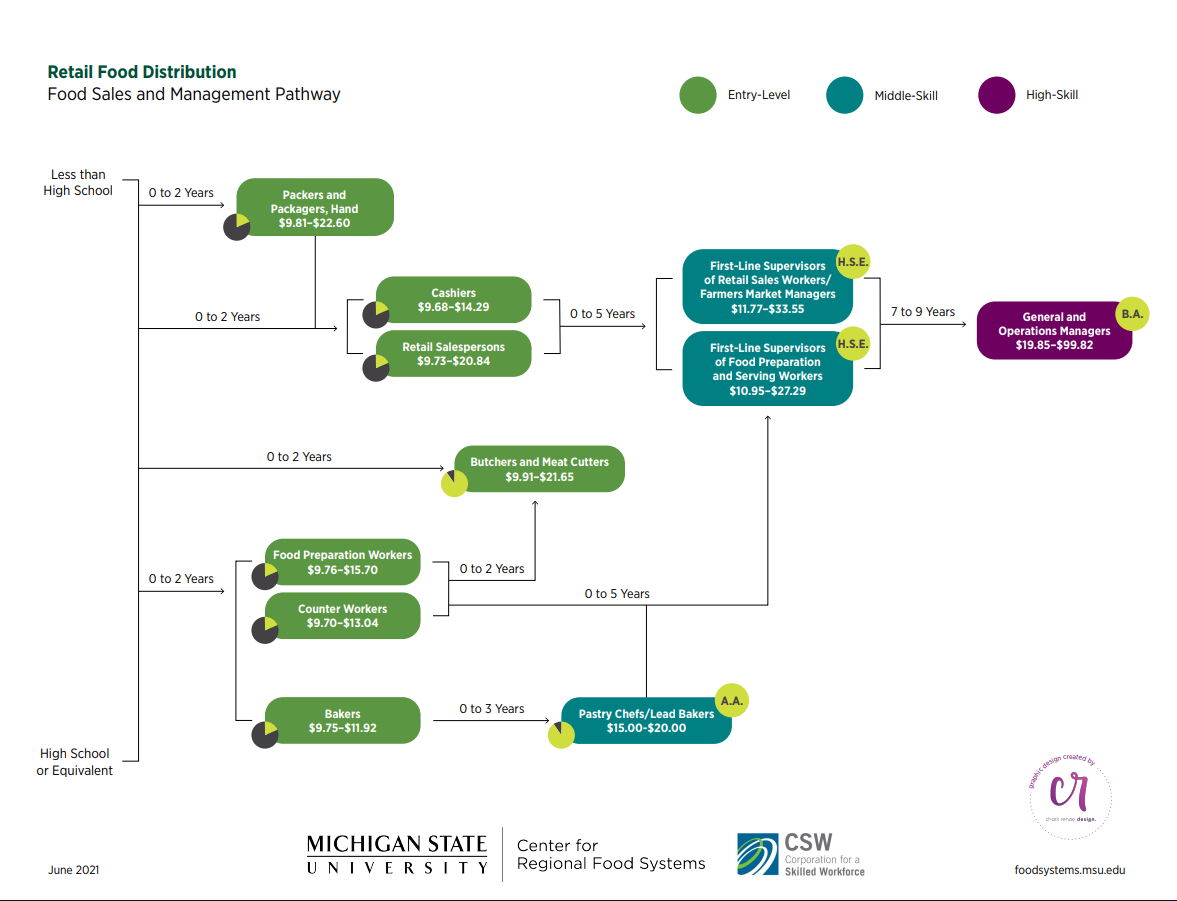
Retail Food Distribution Career Pathway Maps
Download in English
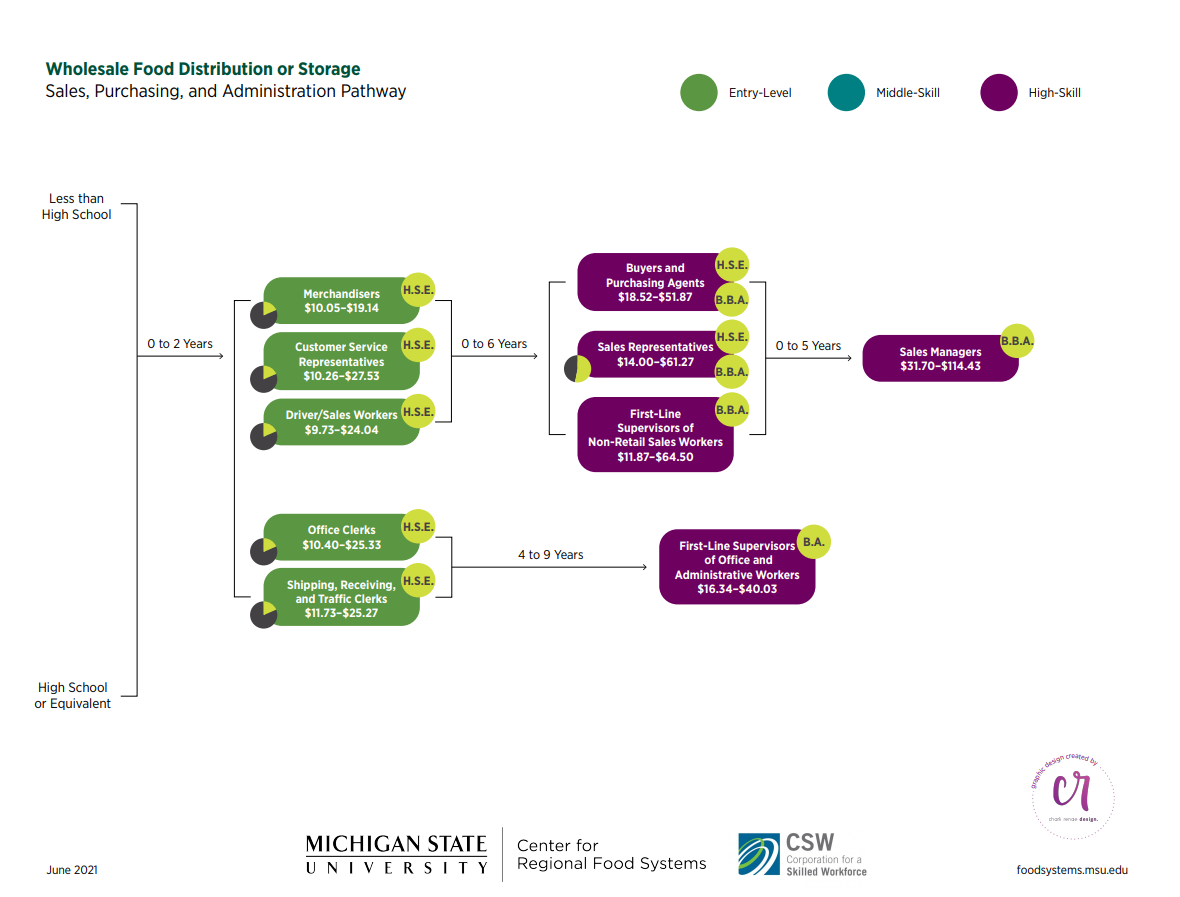
Wholesale Food Distribution or Storage Pathway Maps
Download in English
Michigan Local and Regional Food Systems Workforce Assessment
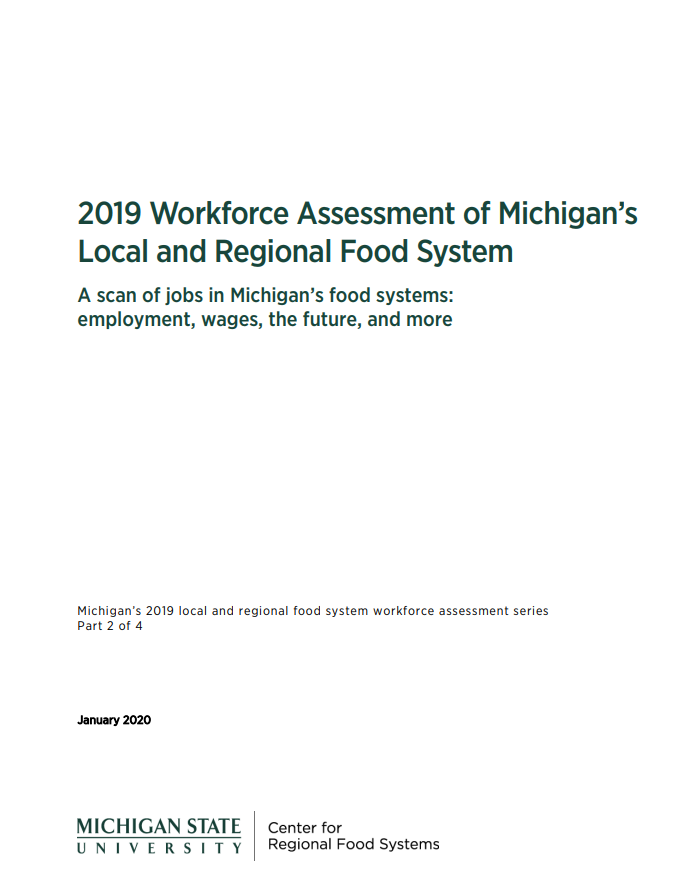
In 2019, with funding from the W.K. Kellogg Foundation and Kalamazoo Valley Community College, Michigan State University Center for Regional Food Systems and CSW authored the “2019 Workforce Assessment of Michigan’s Local and Regional Food System.” The goal of this analysis was to better understand:
- the local and regional food system job categories that represent the most significant areas of employment within the food system,
- the wage data associated with those jobs,
- the skills that are required to fulfill those jobs, and
- growth projections in specific fields of employment.
This job scan analyzed the following core industries within local and regional food systems:
- Food Production,
- Farm Inputs,
- Wholesale Distribution,
- Manufacturing and Processing, and
- Food Retail
Allied industries were also included in data analysis.
CSW Contributors

Megan Elyse Williams
Director of Research & Evaluation

Chris Webb
Research Associate

Diamond Dickerson
Senior Policy Associate
Join us in improving education and career outcomes:
Support improvements in worker skills, lifelong learning, and job quality: